Construction & Real Estate
Building Materials and Equipment Tracking System
Track cement, steel, aggregates, tools and equipment from purchase to site, with stores per project, transfers, tool issue to workers and material reconciliation against BOQ.
- Web-based
- Android
Overview
Building Materials and Equipment Tracking System
Materials are usually the largest cost on a construction project, and the easiest place to lose money. A Building Materials and Equipment Tracking System records every bag of cement, tonne of reinforcement and trip of aggregates from purchase order to site store to the element where it was used. Extrion Tech can develop it in-house for contractors, suppliers and developers who need a clear chain of custody for materials and tools.
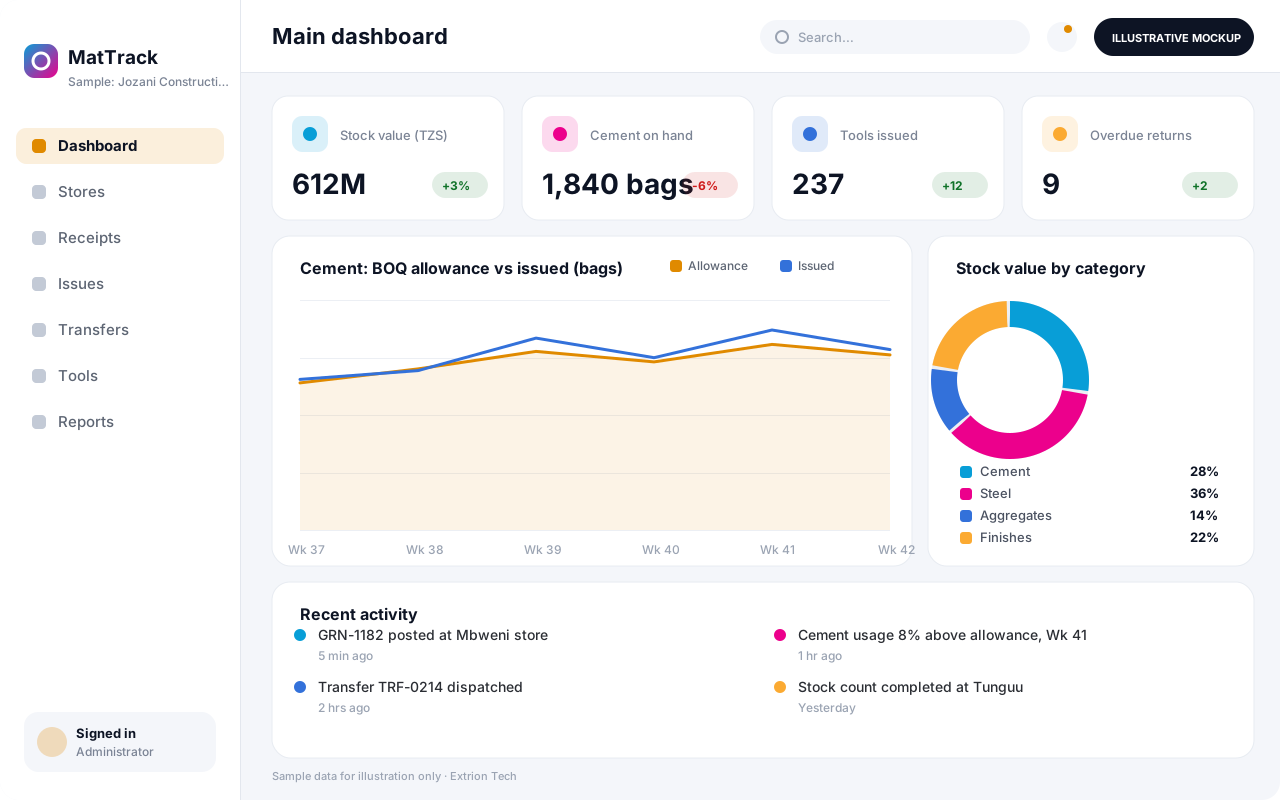
Each project or yard has its own store. Deliveries are received against purchase orders and delivery notes, quantities are checked, and stock is issued to activities or gangs with a requisition reference. Transfers between sites in Zanzibar, Pemba or the mainland are recorded as dispatches and receipts so nothing disappears in transit. Theoretical usage is calculated from BOQ quantities and wastage allowances, and the system compares it with actual issues to highlight over-consumption early.
Tools and equipment such as vibrators, generators, levels and formwork panels are tagged with codes or QR labels, issued to named workers or foremen, and tracked for return, servicing and calibration. Periodic stock counts are entered on a tablet and variances are reported for investigation. The scope can be limited to materials only, or extended to equipment hire, supplier price tracking and integration with an accounting or procurement system.
Business problems it addresses
- Materials delivered to site are not matched to purchase orders or delivery notes.
- Cement and steel consumption exceeds the BOQ allowance without anyone noticing.
- Tools and small equipment go missing because nobody signs for them.
- Transfers between sites are untracked, so stock balances never match.
- Stock counts are rare and variances cannot be explained.
Interface
Five screens of the system
Illustrative mockups with sample data — not screenshots of a client’s system.
Workflow
From purchase order to reconciliation
-
1
Purchase order
Procurement raises an order to the supplier for a project store.
-
2
Goods receipt
Storekeeper checks the delivery note and records quantities received.
-
3
Store and tag
Materials are binned by location; tools receive a QR or barcode tag.
-
4
Issue to activity
Stock or tools are issued against a requisition to a gang or activity.
-
5
Transfers
Surplus materials are dispatched to another site and received there.
-
6
Returns and servicing
Tools are returned, checked and sent for servicing when due.
-
7
Count and reconcile
Physical counts are compared with records and BOQ usage allowances.
Functions covered
Modules and what they do
01 Materials
-
Material catalogue
Defines items, units, conversion factors and wastage allowances.
-
Goods received notes
Records deliveries against purchase orders and supplier delivery notes.
-
Requisitions and issues
Issues stock to activities or gangs with an approved requisition.
-
Inter-site transfers
Tracks dispatches and receipts between stores and in-transit stock.
-
BOQ usage reconciliation
Compares theoretical usage from BOQ quantities with actual issues.
02 Tools and equipment
-
Equipment register
Holds tools and equipment with tag, value, location and condition.
-
Issue and return
Records who holds each item and flags overdue returns.
-
Servicing and calibration
Schedules services and calibration for levels, generators and mixers.
-
Equipment hire tracking
Optional / subject to scope
Manages hired-in or hired-out equipment with hire periods and charges.
03 Control
-
Stock counts
Runs cycle and full counts on tablets and reports variances.
-
Supplier price history
Optional / subject to scope
Tracks unit prices by supplier to support purchasing decisions.
-
Accounting export
Optional / subject to scope
Sends receipts and issues to the finance system where an API is available.
Technology stack
Technology selected for this solution
These are the technologies planned for this type of system. The final stack depends on scale, performance, licensing, infrastructure, integrations and your requirements.
Frontend
Backend
Database
Mobile
Infrastructure
Integrations
Security & data integrity
Protecting your data and its accuracy
Store staff can only post transactions for the stores they are assigned to, and stock adjustments require a supervisor’s approval with a recorded reason.
Standard protections
-
Role-based access control
Each user sees only what their role allows.
-
Authentication and authorisation
Every request is checked for a signed-in, permitted user.
-
Fine-grained permissions
Permissions per module and action, such as view, edit or approve.
-
Secure password storage
Passwords are stored using strong one-way hashing, never in plain text.
-
Encryption in transit
HTTPS/TLS protects data between users and the server.
-
Server-side input validation
All input is validated on the server before it is saved.
-
Protection against common web vulnerabilities
Defences against injection, cross-site scripting and request forgery.
-
Database constraints and transactions
Constraints and transactions keep related records consistent.
-
Audit logs
Important actions are recorded with who, what and when.
-
User activity history
A history of each user’s activity for supervisors and administrators.
-
Backup and restoration
Scheduled backups with tested restoration procedures.
-
Session management
Session time-outs and the ability to sign out other devices.
-
Offline mode with controlled synchronisation
Work offline and synchronise safely when the connection returns.
Optional advanced protections
- Multi-factor authentication A second sign-in step for selected or all users.
- Disaster recovery planning A documented plan to restore service after a major failure.
- Data export controls Exports limited to authorised roles and recorded.
Data integrity
Issues cannot exceed available stock, and every receipt, issue, transfer and adjustment is posted as a dated transaction so balances can be rebuilt at any point. Transfers stay in transit until received, and count variances are recorded as approved adjustments rather than overwritten balances.
Security controls are configured for each project. We do not claim certification, compliance or immunity from attack unless independently verified for your deployment.
Customisation & integration
Tailored to how you work
We tailor modules, reports, permissions, workflows, branding and integrations to your organisation. Tell us which features you need when you request a quote.
- Material catalogue, units and wastage allowances
- Store structure per project, yard or warehouse
- Tag formats and label printing
- Approval rules for requisitions and adjustments
- Reports on usage, losses and supplier performance
Deployment & support
From go-live to continuous improvement
Onboarding, data migration, training, maintenance, technical support and future enhancements are services we scope into your project.
Bringing records from spreadsheets or older systems, checked and reconciled.
Role-based training for users, supervisors and administrators.
Technical support and maintenance under an agreed support plan.
New modules, reports and integrations as your organisation grows.
Pricing
Pricing tailored to your requirements
Every organisation has different workflows, users, infrastructure, and integration needs. Request a quotation for a solution designed around your requirements.
- Number of users, branches and modules
- Customisation and integrations
- Hosting: cloud, your server or hybrid
- Data migration and training
- Support and maintenance plan
Construction & Real Estate
Related systems
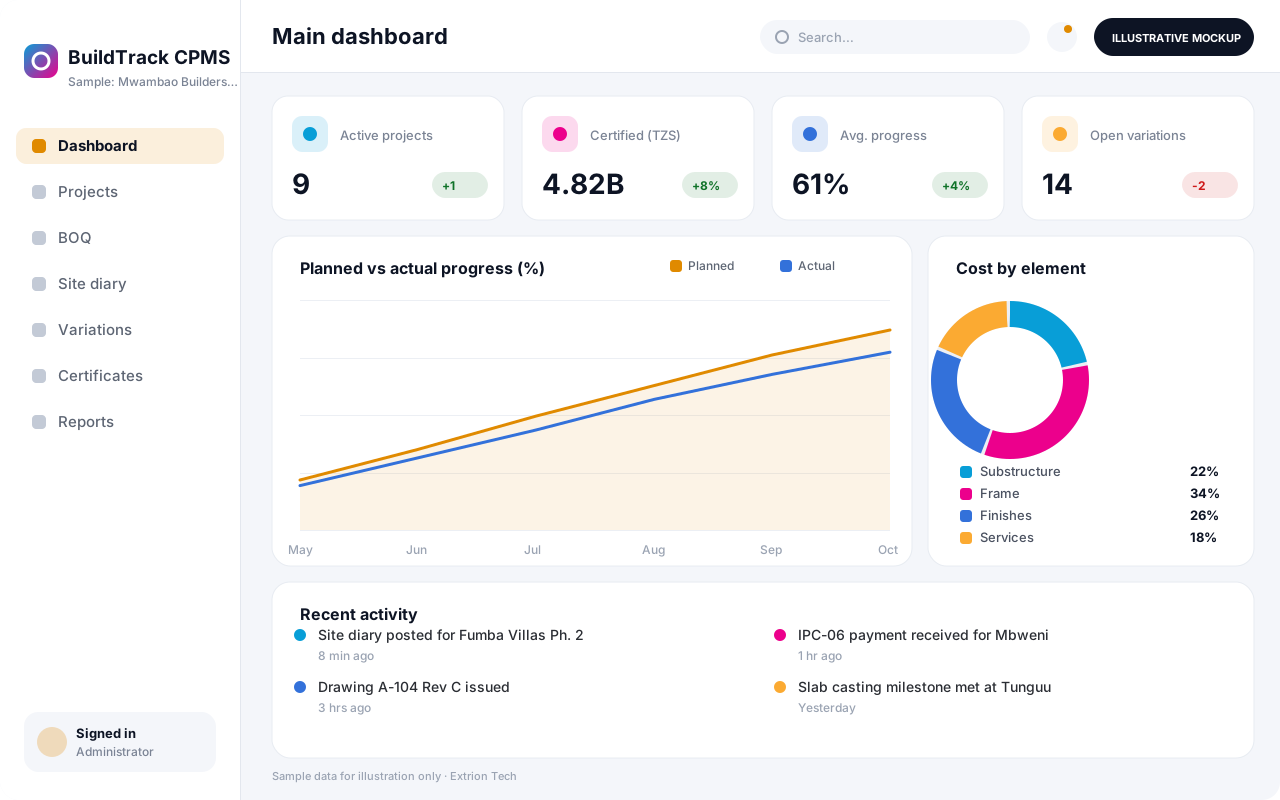 Construction Project Management System A custom platform to plan construction projects, track progress against the bill of quantities, control budgets and variations, and manage interim payment certificates.
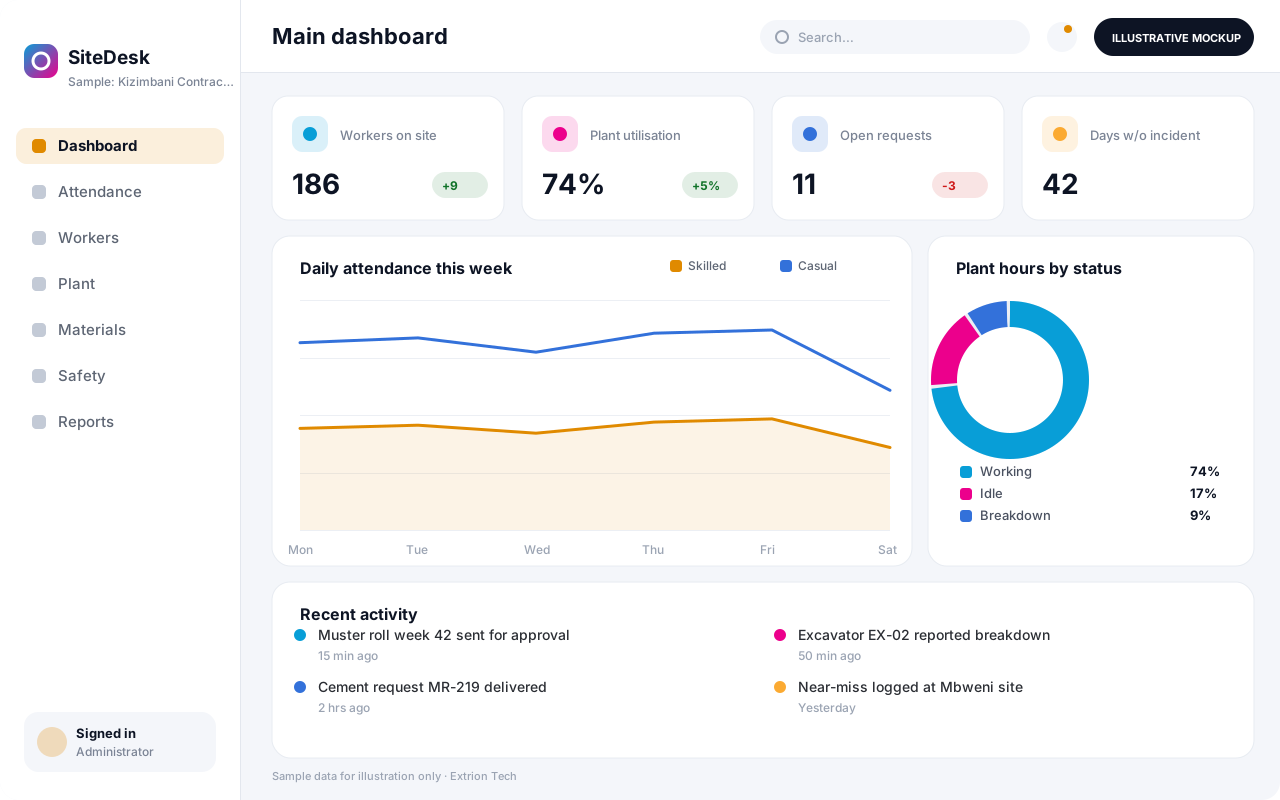 Contractor and Site Operations Management System Day-to-day site control for contractors: labour attendance and casual payroll, plant usage, material requests, safety inspections and daily reports from every active site.
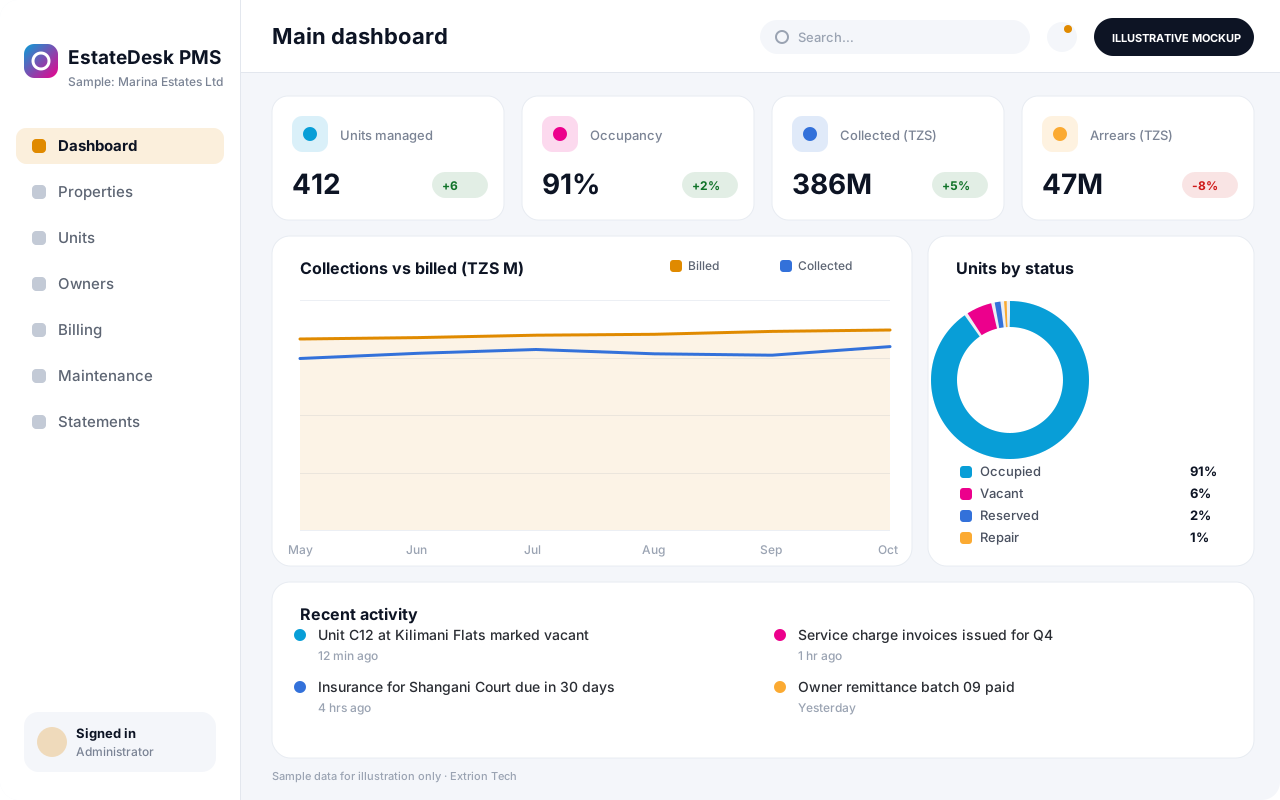 Property Management System Manage a portfolio of buildings, units and owners in one system: occupancy, owner statements, service charges, maintenance and property-level income and expenses.
Back to the catalogue Business software services Our development process
