Healthcare
Laboratory Information Management System
Tracks every sample from request and collection through testing, verification and reporting, with turnaround monitoring, quality control and reagent stock.
- Web-based
- Server-based
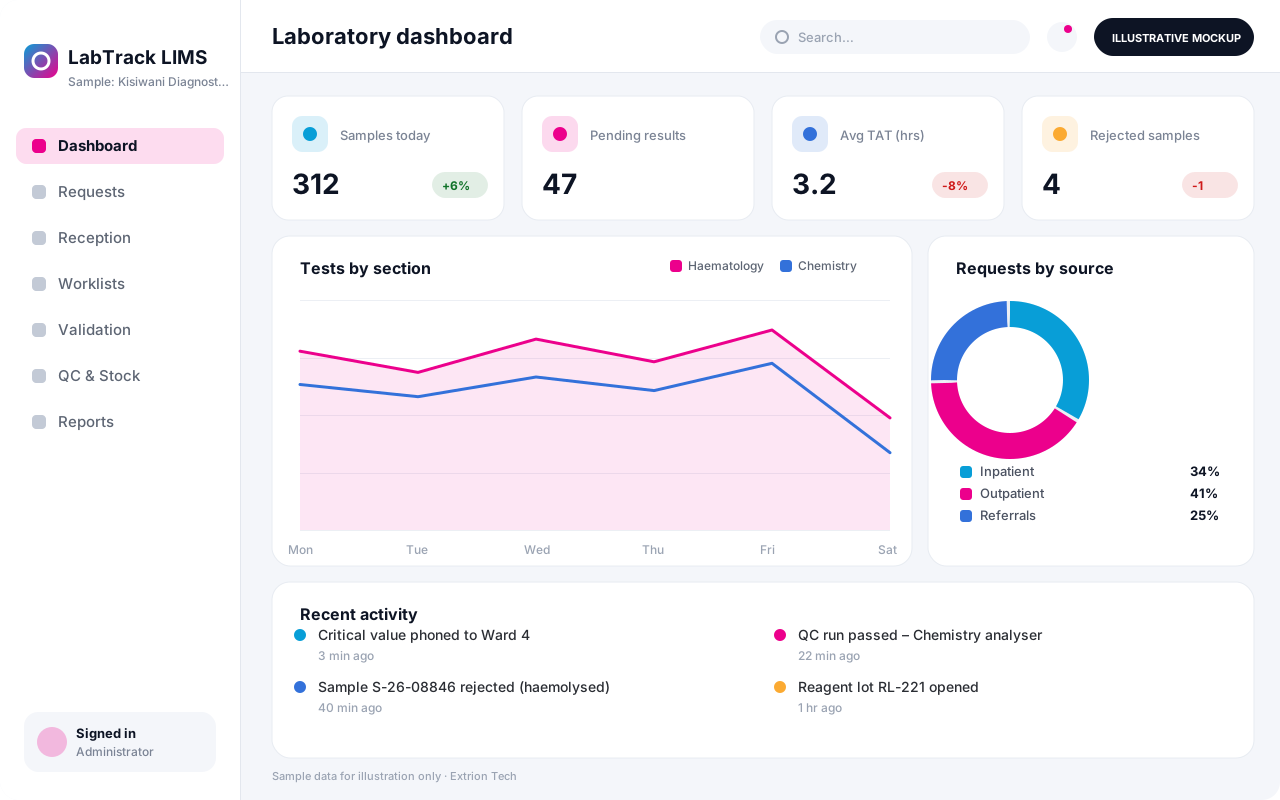
Overview
Laboratory Information Management System (LIMS)
In a laboratory, accuracy depends on knowing exactly which sample belongs to which patient and which result has been checked. A Laboratory Information Management System labels each specimen at collection, follows it through the bench, and releases results only after they have been entered, validated and authorised by the right people.
Extrion Tech builds LIMS solutions in-house for hospital laboratories, private diagnostic centres and research or public health labs in Zanzibar and Tanzania. Test catalogues, reference ranges, sample types and approval steps are configured to your laboratory’s own procedures. Where analysers support a standard interface and the project scope includes it, results can be captured directly instead of retyped.
Laboratory managers gain live visibility of pending work, turnaround times and quality control results, while requesting clinicians and referring facilities receive clear, consistently formatted and signed reports by print, portal or SMS notification. Reagent and consumable stock is tracked against the tests actually performed, so shortages are seen early. Data retention, confidentiality and any accreditation-related requirements are agreed with the laboratory for the relevant jurisdiction.
Business problems it addresses
- Samples are mislabelled or mixed up when identification relies on handwritten tubes and registers.
- Results are transcribed by hand from analysers, introducing errors and delays.
- Nobody can tell which samples are overdue until a clinician calls to complain.
- Quality control records are kept on paper and are hard to review over time.
- Reagents run out unexpectedly because usage is not linked to tests performed.
Interface
Five screens of the system
Illustrative mockups with sample data — not screenshots of a client’s system.
Workflow
The life of a sample
-
1
Test request
A clinician or referring facility submits a request with patient details and the tests required.
-
2
Sample collection
The specimen is collected and a barcode label linking it to the patient and request is printed.
-
3
Sample reception
The lab accepts or rejects the sample, recording condition and time received.
-
4
Testing
Work lists are sent to benches or analysers and results are captured against each test.
-
5
Validation
Results are checked against reference ranges, QC status and critical value rules.
-
6
Authorisation
A senior scientist authorises the results before they are released.
-
7
Reporting
Reports reach the clinician by print, portal or notification, and turnaround is recorded.
Functions covered
Modules and what they do
01 Sample handling
-
Requests and registration
Captures test requests from wards, clinics or external referrers.
-
Barcode labelling
Prints specimen labels and tracks each sample by scanning.
-
Sample reception and rejection
Logs receipt time, sample condition and reasons for rejection.
02 Testing and results
-
Test catalogue
Defines tests, panels, sample types, units and reference ranges.
-
Result entry and validation
Records results, flags abnormal and critical values and routes them for review.
-
Analyser interface
Optional / subject to scope
Imports results from analysers that support a standard interface.
03 Quality and stock
-
Quality control
Records control runs and plots them on charts to spot drift.
-
Reagents and consumables
Tracks lots, expiry and usage per test with reorder alerts.
-
Equipment maintenance
Optional / subject to scope
Schedules calibration and maintenance and logs breakdowns.
04 Reporting
-
Result reports
Produces formatted, authorised reports per patient or referrer.
-
Referrer portal
Optional / subject to scope
Lets referring clinics view and download their patients’ results.
-
Workload and TAT reports
Reports tests per section, turnaround times and rejection rates.
Technology stack
Technology selected for this solution
These are the technologies planned for this type of system. The final stack depends on scale, performance, licensing, infrastructure, integrations and your requirements.
Frontend
Backend
Database
Infrastructure
Integrations
Security & data integrity
Protecting your data and its accuracy
Results can be edited only before authorisation, and only by permitted scientists; released reports are locked and amendments are versioned. Confidentiality, retention and accreditation-related requirements are agreed with the laboratory for the relevant jurisdiction.
Standard protections
-
Role-based access control
Each user sees only what their role allows.
-
Authentication and authorisation
Every request is checked for a signed-in, permitted user.
-
Fine-grained permissions
Permissions per module and action, such as view, edit or approve.
-
Secure password storage
Passwords are stored using strong one-way hashing, never in plain text.
-
Encryption in transit
HTTPS/TLS protects data between users and the server.
-
Server-side input validation
All input is validated on the server before it is saved.
-
Protection against common web vulnerabilities
Defences against injection, cross-site scripting and request forgery.
-
Database constraints and transactions
Constraints and transactions keep related records consistent.
-
Audit logs
Important actions are recorded with who, what and when.
-
User activity history
A history of each user’s activity for supervisors and administrators.
-
Backup and restoration
Scheduled backups with tested restoration procedures.
-
Session management
Session time-outs and the ability to sign out other devices.
-
Data retention and deletion policies
Retention periods and deletion rules agreed with you.
Optional advanced protections
- Multi-factor authentication A second sign-in step for selected or all users.
- Encryption at rest Sensitive data encrypted on disk where the infrastructure supports and is configured for it.
- Secure API access Authenticated, rate-limited access for integrations.
- Disaster recovery planning A documented plan to restore service after a major failure.
Data integrity
Every sample carries a unique barcode tied to one request and one patient, and results can only be recorded against tests that were ordered. Values are validated against units and plausible ranges, authorisation is a separate recorded step, and any correction after release creates an amended report with the original preserved.
Security controls are configured for each project. We do not claim certification, compliance or immunity from attack unless independently verified for your deployment.
Customisation & integration
Tailored to how you work
We tailor modules, reports, permissions, workflows, branding and integrations to your organisation. Tell us which features you need when you request a quote.
- Test catalogue, panels and reference ranges
- Validation and authorisation levels per section
- Report templates, signatures and laboratory branding
- Critical value rules and notification recipients
- Analyser and hospital system integrations
Deployment & support
From go-live to continuous improvement
Onboarding, data migration, training, maintenance, technical support and future enhancements are services we scope into your project.
Bringing records from spreadsheets or older systems, checked and reconciled.
Role-based training for users, supervisors and administrators.
Technical support and maintenance under an agreed support plan.
New modules, reports and integrations as your organisation grows.
Pricing
Pricing tailored to your requirements
Every organisation has different workflows, users, infrastructure, and integration needs. Request a quotation for a solution designed around your requirements.
- Number of users, branches and modules
- Customisation and integrations
- Hosting: cloud, your server or hybrid
- Data migration and training
- Support and maintenance plan
Healthcare
Related systems
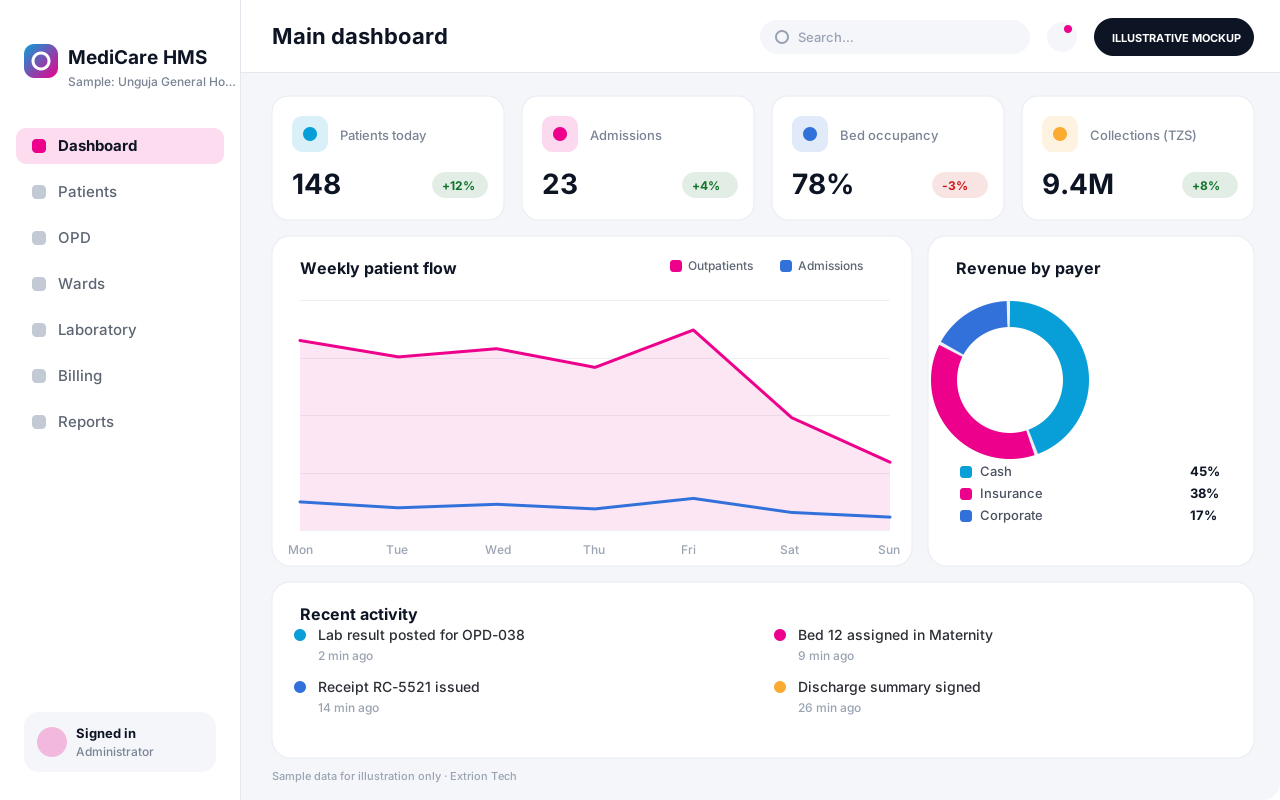 Hospital Management System An integrated hospital system connecting registration, outpatient and inpatient care, laboratory, pharmacy, billing and reporting in one secure platform.
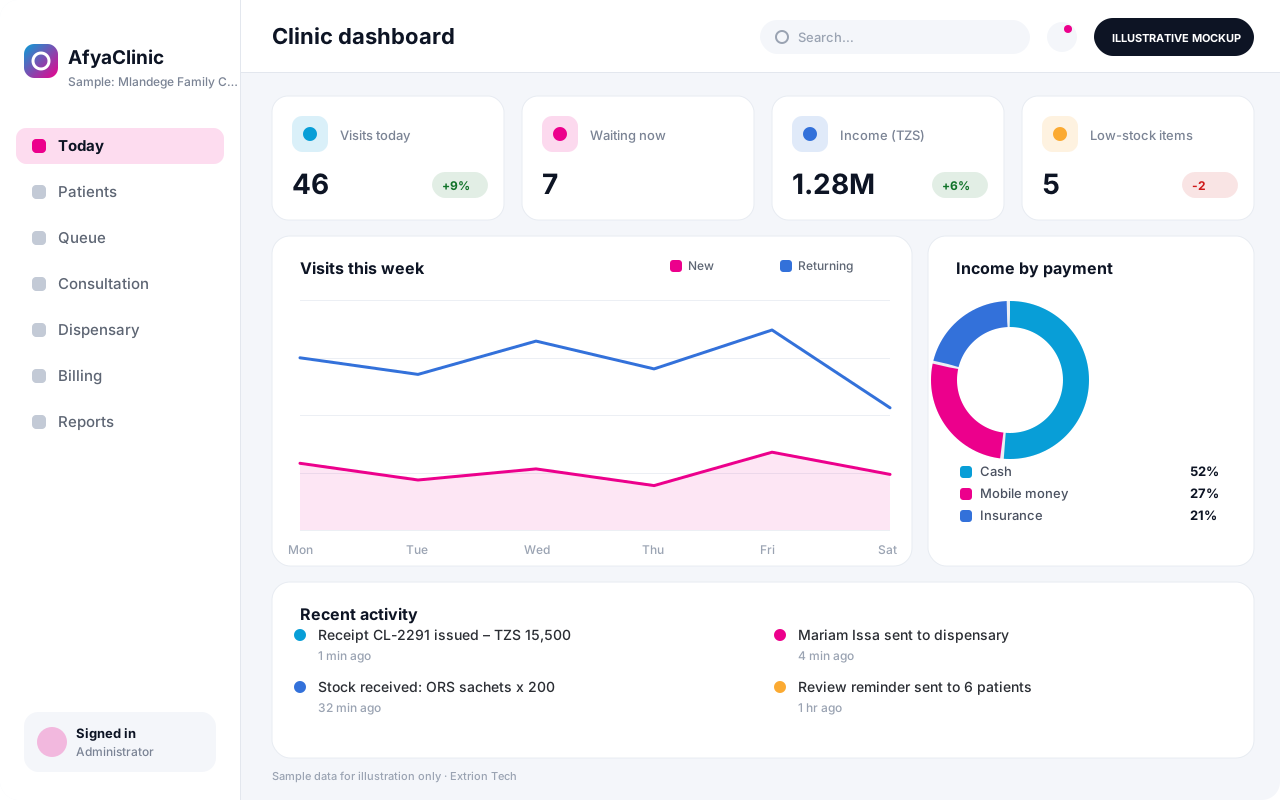 Clinic Management System A lean system for private clinics and dispensaries that handles patient visits, consultations, dispensing, simple lab work and cash or insurance billing.
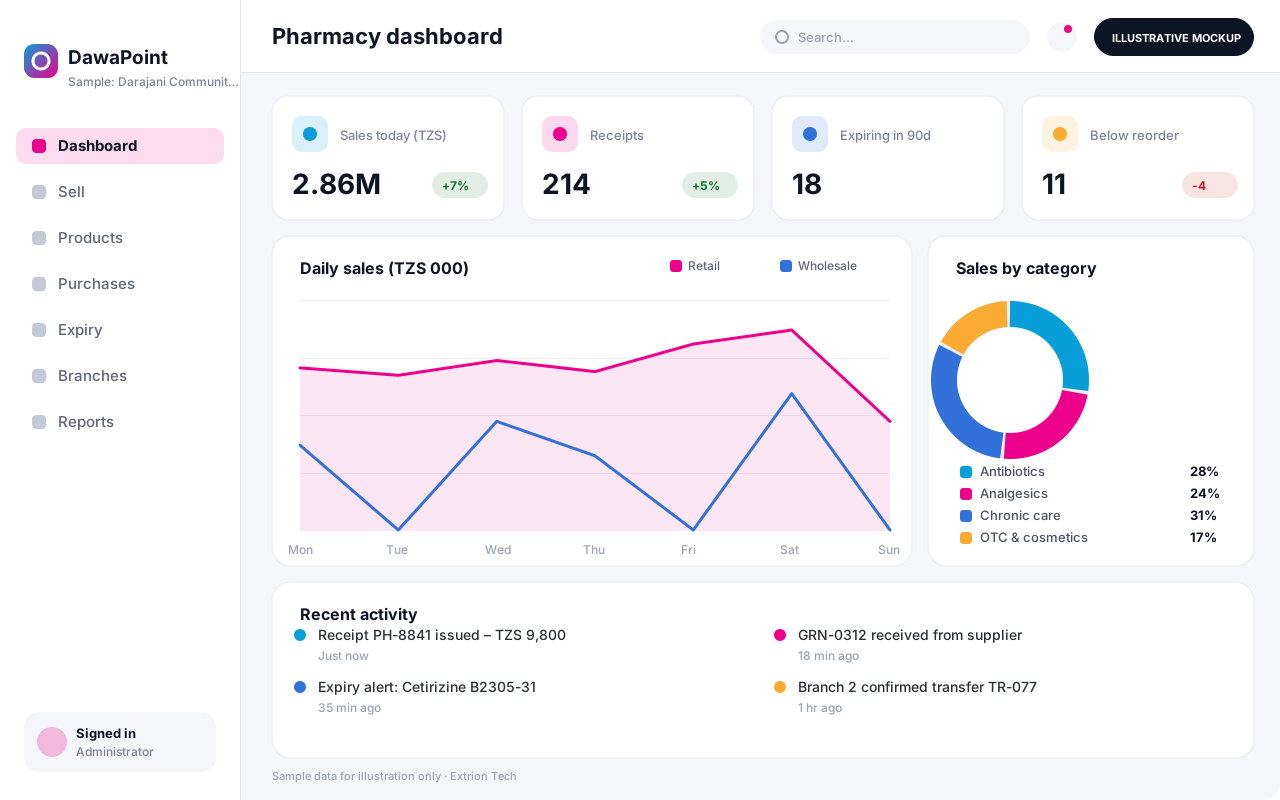 Pharmacy Management System Point-of-sale and stock control for retail and wholesale pharmacies, with batch and expiry tracking, prescriptions, supplier orders and branch reporting.
Back to the catalogue Business software services Our development process
