Transport & Logistics
Transport and Route Management System
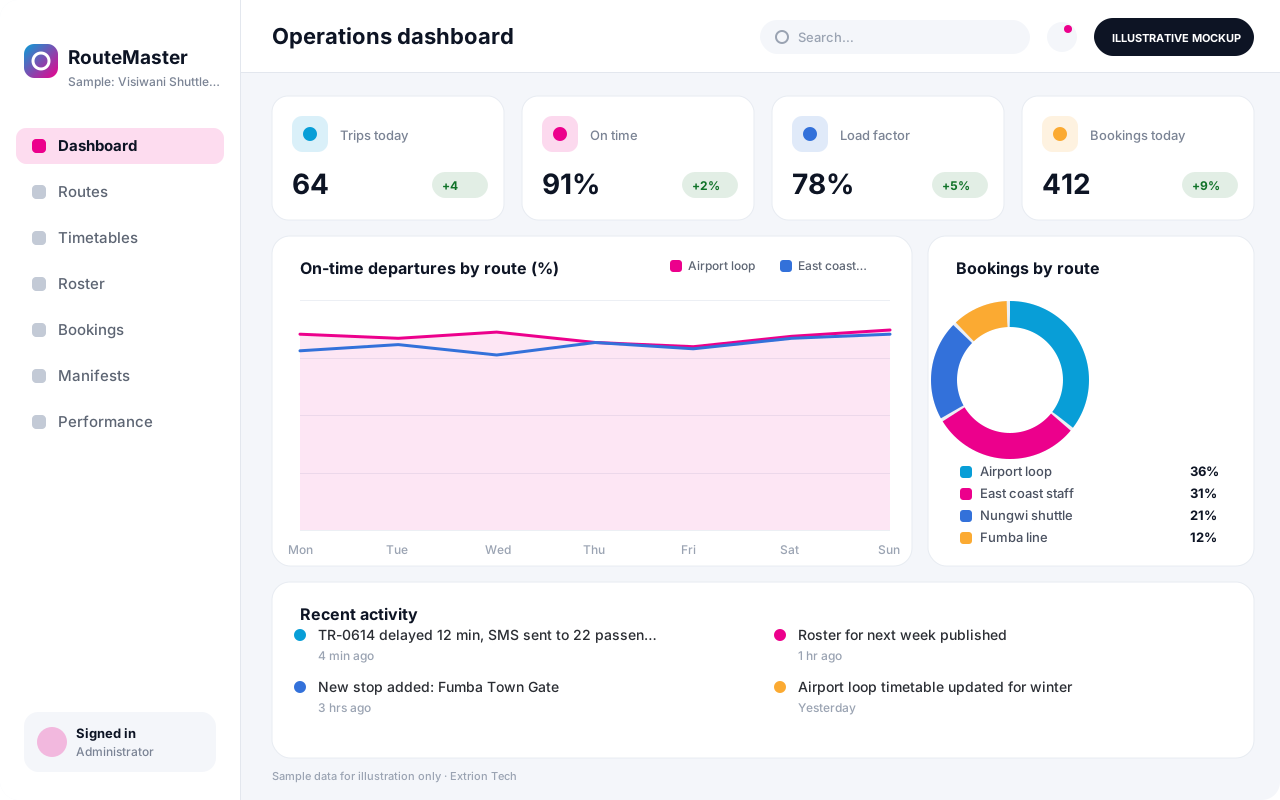
A route planning and scheduling system for scheduled transport, defining routes, stops, timetables and vehicle rosters, with bookings, manifests and on-time performance reporting.
- Web-based
- Android
- iOS
Overview
Transport and Route Management System
A Transport and Route Management System organises regular, repeated movements: staff buses, school transport, shuttle services, scheduled cargo runs and inter-regional coaches. Extrion Tech develops the system so routes, stops, timetables and vehicle rosters are defined once and then run day after day with clear manifests and measured performance.
Planners build routes with ordered stops and expected times, for example a hotel staff shuttle from Mwanakwerekwe to the east coast, an airport transfer circuit, or a weekly cargo run linking Dar es Salaam with Morogoro and Dodoma. Vehicles and drivers are rostered to each trip, taking capacity and rest periods into account. Where bookings are needed, passengers or shippers reserve seats or space, and the system produces a manifest for each departure.
During operation, drivers or supervisors confirm departures and arrivals at each stop, so delays are visible and passengers can be informed by SMS. Over time, on-time performance, load factor and revenue per route show which services need extra capacity, new timing or withdrawal. Map-based route display and integration with GPS tracking are available where in scope, using PostGIS for route geometry when the project requires spatial analysis.
Business problems it addresses
- Timetables and rosters live in spreadsheets that drivers rarely see.
- Buses run full on some routes and nearly empty on others.
- Passengers and customers do not know when a vehicle is delayed.
- Manifests are handwritten, so nobody knows who or what is on board.
- Management has no evidence of on-time performance by route.
Interface
Five screens of the system
Illustrative mockups with sample data — not screenshots of a client’s system.
Workflow
From route design to performance review
-
1
Route design
Define routes with ordered stops, distances and expected stop times.
-
2
Timetable
Set departures by day of week, season and service type.
-
3
Rostering
Assign vehicles and drivers to trips within capacity and rest rules.
-
4
Bookings
Passengers or shippers reserve seats or cargo space on a departure.
-
5
Manifest and departure
Issue the manifest and confirm boarding and departure time.
-
6
Stop updates
Record arrival at each stop and notify customers of delays.
-
7
Performance review
Analyse punctuality, load factor and revenue by route.
Functions covered
Modules and what they do
01 Planning
-
Route and stop builder
Creates routes with stops, distances and expected running times.
-
Timetables
Manages regular and seasonal departures and service exceptions.
-
Rostering
Assigns vehicles and drivers to trips and checks for clashes.
02 Operations
-
Bookings and reservations
Takes seat or cargo space bookings per departure.
-
Manifests
Lists booked passengers or consignments for each departure.
-
Trip execution
Records departures, stop arrivals and delays from the driver app or depot.
-
Passenger notifications
Optional / subject to scope
Sends booking confirmations and delay alerts by SMS or email.
03 Analysis and integration
-
Route performance
Reports punctuality, load factor and revenue per route and trip.
-
Map view
Optional / subject to scope
Displays routes and stops on a map with spatial analysis using PostGIS.
-
GPS tracking integration
Optional / subject to scope
Shows live vehicle positions where the tracking provider offers an API.
-
Online booking payments
Optional / subject to scope
Collects mobile money or card payments where a provider API is available.
Technology stack
Technology selected for this solution
These are the technologies planned for this type of system. The final stack depends on scale, performance, licensing, infrastructure, integrations and your requirements.
Frontend
Backend
Database
Mobile
Infrastructure
Integrations
Security & data integrity
Protecting your data and its accuracy
Passenger names and phone numbers on manifests are visible only to staff operating that trip, and retention of booking and travel history is agreed with the client.
Standard protections
-
Role-based access control
Each user sees only what their role allows.
-
Authentication and authorisation
Every request is checked for a signed-in, permitted user.
-
Fine-grained permissions
Permissions per module and action, such as view, edit or approve.
-
Secure password storage
Passwords are stored using strong one-way hashing, never in plain text.
-
Encryption in transit
HTTPS/TLS protects data between users and the server.
-
Server-side input validation
All input is validated on the server before it is saved.
-
Protection against common web vulnerabilities
Defences against injection, cross-site scripting and request forgery.
-
Database constraints and transactions
Constraints and transactions keep related records consistent.
-
Audit logs
Important actions are recorded with who, what and when.
-
Session management
Session time-outs and the ability to sign out other devices.
-
Secure API access
Authenticated, rate-limited access for integrations.
-
Backup and restoration
Scheduled backups with tested restoration procedures.
-
Offline mode with controlled synchronisation
Work offline and synchronise safely when the connection returns.
Optional advanced protections
- Multi-factor authentication A second sign-in step for selected or all users.
- Data retention and deletion policies Retention periods and deletion rules agreed with you.
- Monitoring and error logging Errors and unusual activity are logged and monitored.
- Disaster recovery planning A documented plan to restore service after a major failure.
Data integrity
Bookings check remaining capacity inside a transaction, so a seat or cargo slot cannot be sold twice. Roster rules prevent a vehicle or driver being assigned to overlapping trips, and changes to timetables are versioned with effective dates. Recorded stop times are reconciled with GPS data where tracking is integrated.
Security controls are configured for each project. We do not claim certification, compliance or immunity from attack unless independently verified for your deployment.
Customisation & integration
Tailored to how you work
We tailor modules, reports, permissions, workflows, branding and integrations to your organisation. Tell us which features you need when you request a quote.
- Service types: passenger, staff, school or cargo
- Rostering rules for capacity and driver rest
- Booking channels and fare or rate tables
- Notification templates in English and Kiswahili
- Mapping, GPS and payment integrations
Deployment & support
From go-live to continuous improvement
Onboarding, data migration, training, maintenance, technical support and future enhancements are services we scope into your project.
Bringing records from spreadsheets or older systems, checked and reconciled.
Role-based training for users, supervisors and administrators.
Technical support and maintenance under an agreed support plan.
New modules, reports and integrations as your organisation grows.
Pricing
Pricing tailored to your requirements
Every organisation has different workflows, users, infrastructure, and integration needs. Request a quotation for a solution designed around your requirements.
- Number of users, branches and modules
- Customisation and integrations
- Hosting: cloud, your server or hybrid
- Data migration and training
- Support and maintenance plan
Transport & Logistics
Related systems
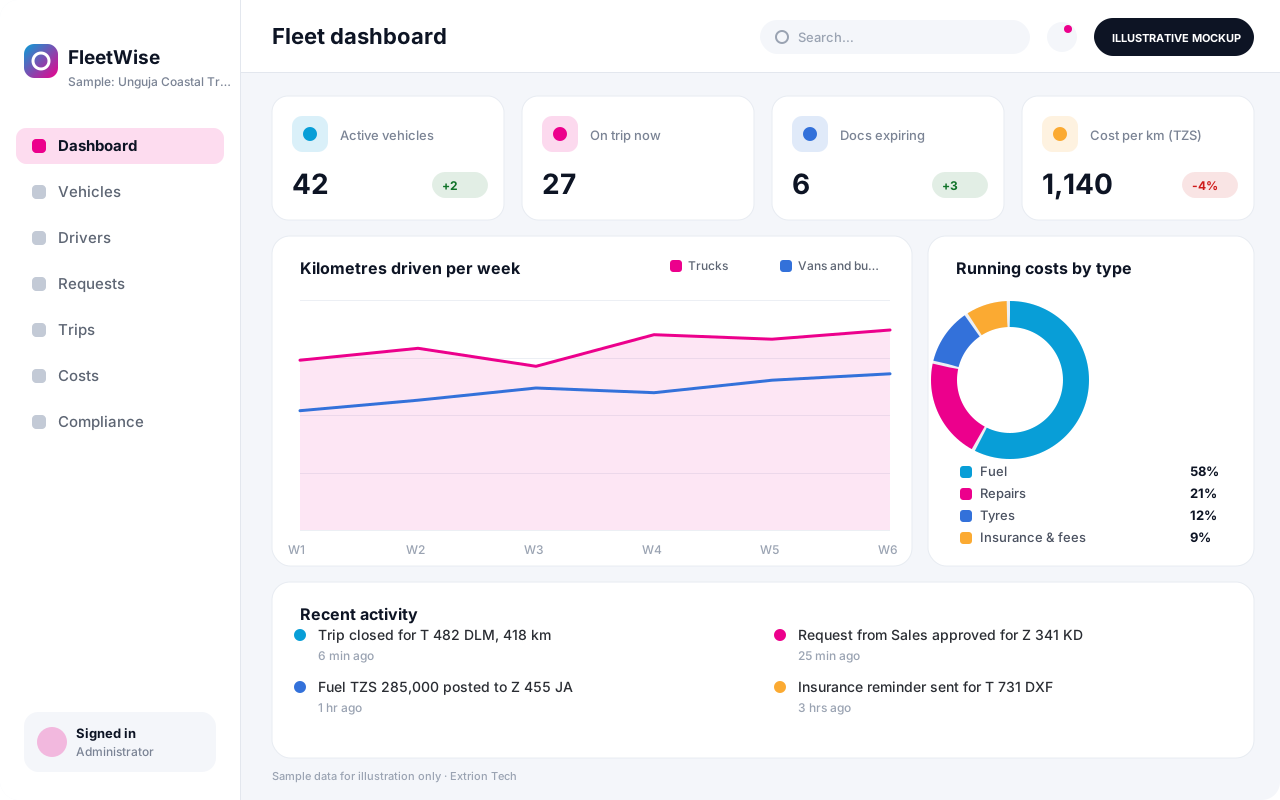 Fleet Management System A fleet system that keeps every vehicle, driver, trip, document and running cost in one place, with GPS tracking integration, licence reminders and cost-per-kilometre reporting.
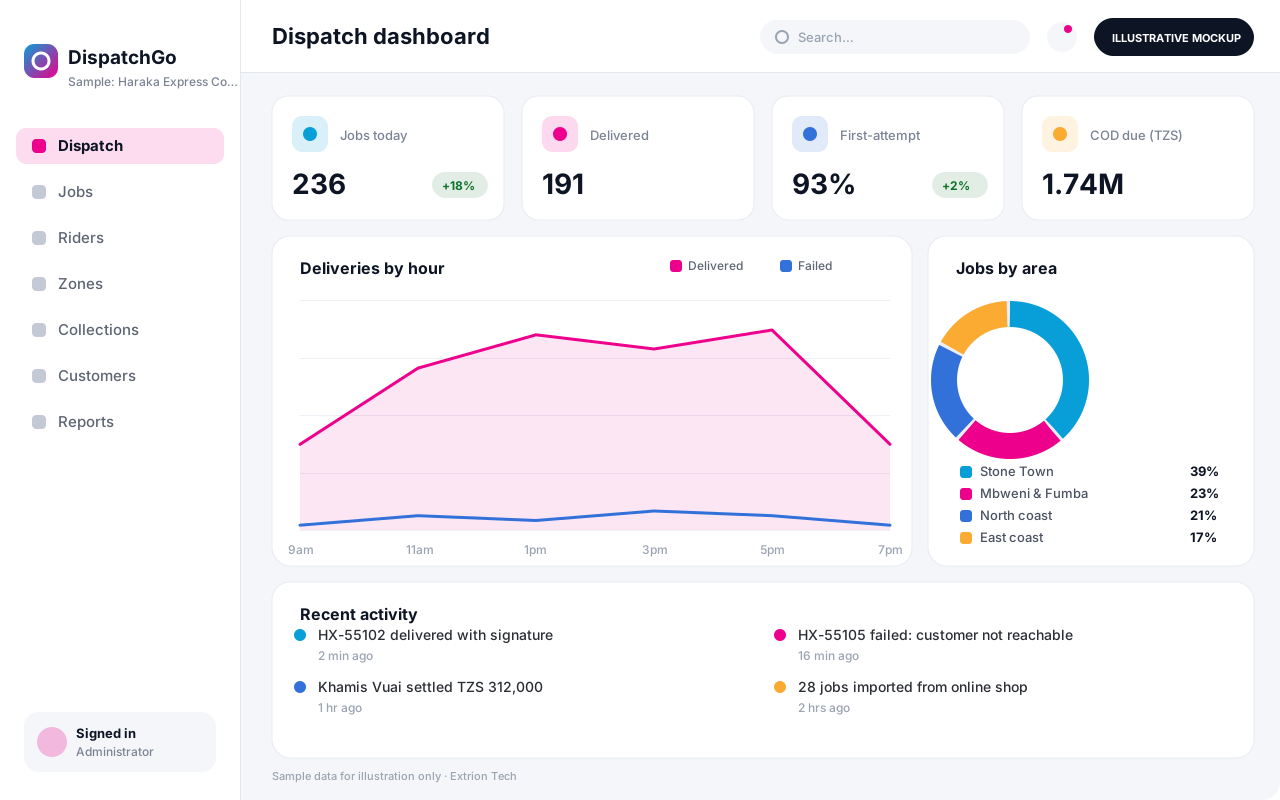 Delivery and Dispatch Management System A dispatch system for same-day and last-mile deliveries that assigns orders to riders and drivers, tracks each job and captures proof of delivery and cash collected.
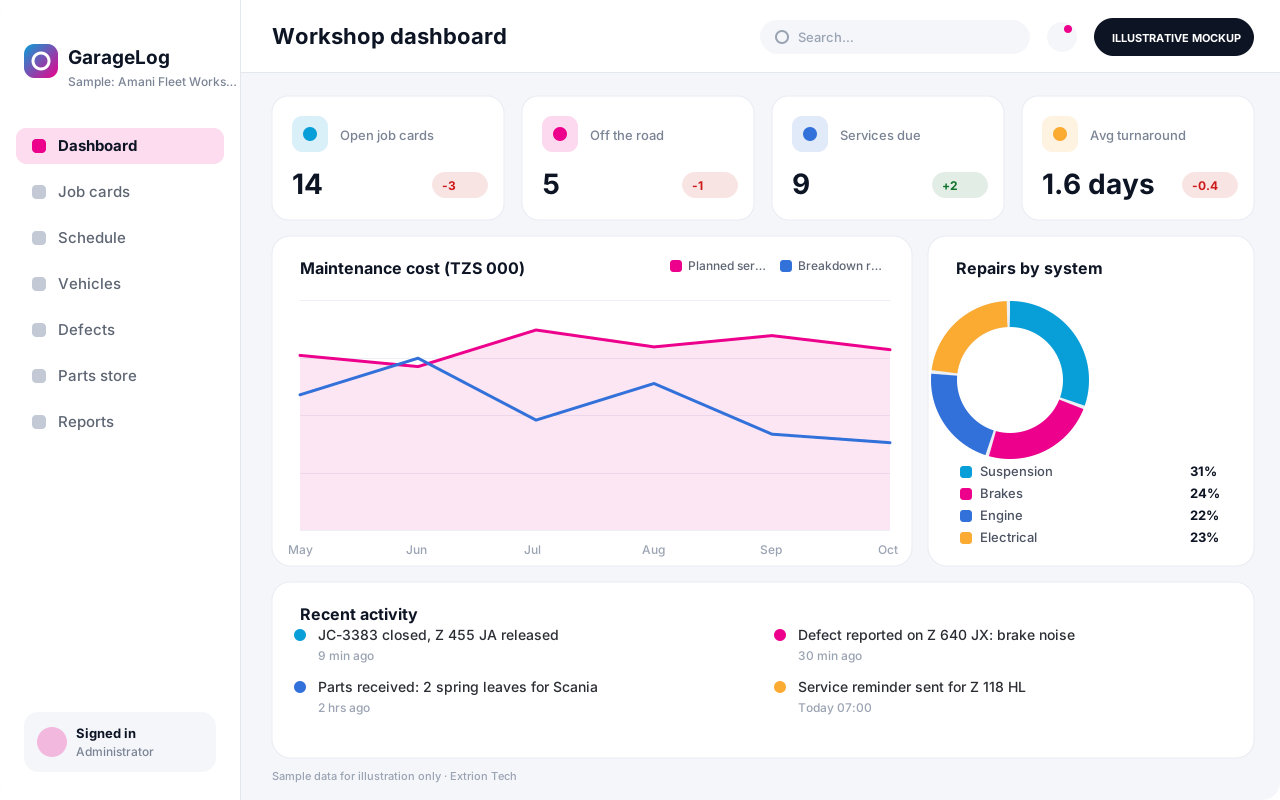 Vehicle Maintenance Management System A workshop and maintenance system that schedules servicing by kilometres or date, manages job cards, parts and labour, and keeps a full repair history for every vehicle.
Back to the catalogue Business software services Our development process
