Education
Examination and Results Management System
Plans examination timetables, seating and invigilation, captures and moderates marks, and publishes grades, divisions, positions and result slips with controlled release.
- Web-based
- Android
Overview
Examination and Results Management System
Examinations concentrate a large amount of work into a few weeks: timetables, seating plans, invigilation rosters, script handling, mark entry, moderation and the release of results. Extrion Tech develops Examination and Results Management Systems in-house in Zanzibar to give examination offices a controlled, traceable process from the first timetable draft to the published result slip.
Examination officers set up each sitting with its papers, dates and venues, generate clash-free timetables and seating plans, and assign invigilators. Candidates receive examination numbers, and marks are captured per paper by authorised teachers or examiners, either directly or by importing approved spreadsheets. Heads of department review distributions, moderate where needed and submit marks for approval before anything is released.
The grading engine applies the institution’s chosen rules: subject grades, averages, positions, GPA or, for secondary schools in Tanzania that want it, an optional NECTA-style division calculation. Results can be released to students and parents by SMS or portal at a scheduled time, and analysis reports compare subjects, classes and previous sittings. Mock examinations, joint examinations across several schools and internal college exams can all be managed on the same platform.
Business problems it addresses
- Timetable clashes and venue overcrowding are discovered only on examination day.
- Marks pass through several hands and spreadsheets, making errors hard to trace.
- Computing grades, divisions and positions for hundreds of candidates takes days.
- Results leak or are changed after release because there is no controlled approval step.
- Schools running joint or mock examinations struggle to combine and rank candidates fairly.
Interface
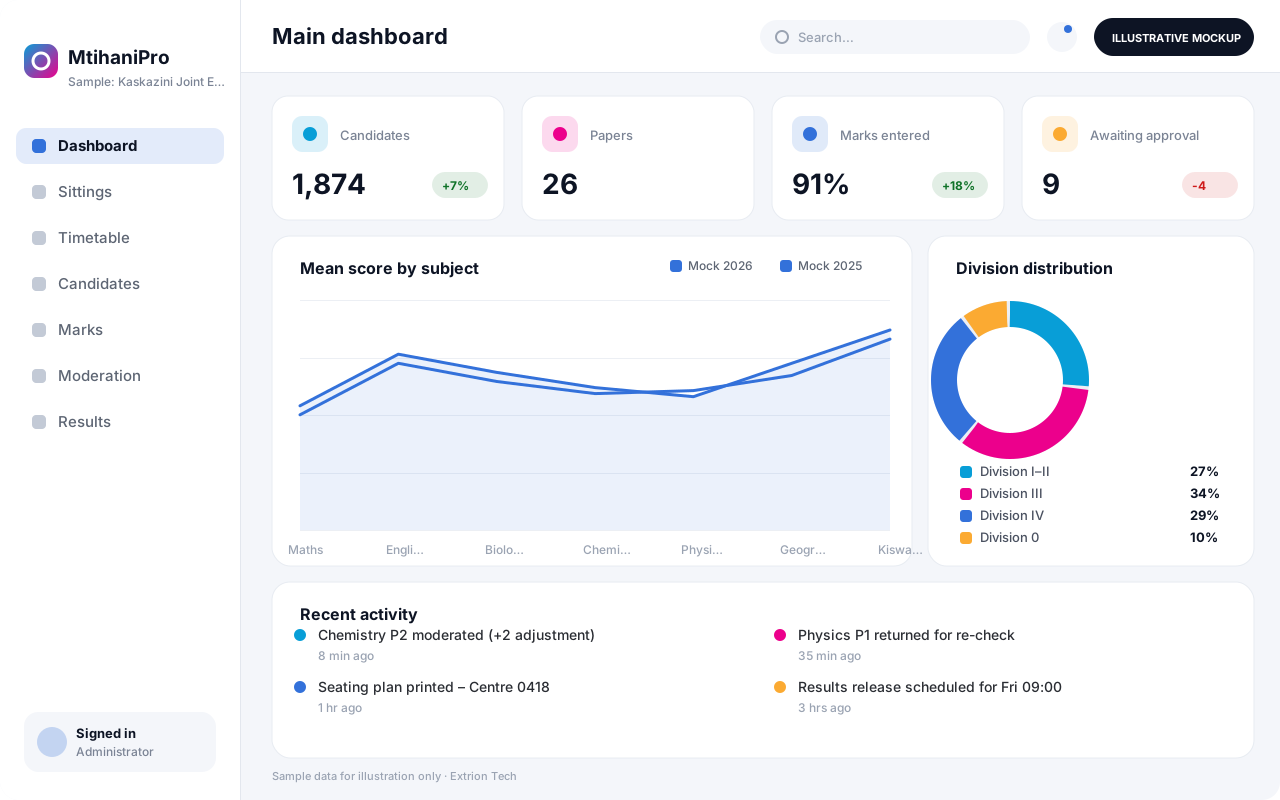
Five screens of the system
Illustrative mockups with sample data — not screenshots of a client’s system.
Workflow
From exam setup to published results
-
1
Sitting setup
Define the examination, classes, papers, maximum marks and grading scheme.
-
2
Timetable and seating
Generate a clash-free timetable, venue allocations and seating plans.
-
3
Candidate numbers
Assign examination numbers and print attendance and seating lists.
-
4
Invigilation and scripts
Roster invigilators and record scripts collected and handed to markers.
-
5
Mark entry
Examiners enter or import marks per paper within allowed ranges.
-
6
Moderation and approval
Heads of department review distributions, moderate and submit for approval.
-
7
Grading and release
Compute grades and positions, then release results at the approved time.
-
8
Results analysis
Compare subjects, classes and sittings to guide teaching improvements.
Functions covered
Modules and what they do
01 Examination planning
-
Examination and paper setup
Defines sittings, papers, durations, maximum marks and weightings.
-
Timetable generator
Schedules papers without candidate or venue clashes.
-
Seating and invigilation
Allocates seats per venue and builds invigilator rosters.
-
Script tracking
Optional / subject to scope
Records script counts from collection through marking and return.
02 Marks and grading
-
Mark entry and import
Captures marks per paper by authorised examiners with range checks.
-
Moderation workflow
Routes marks through department review, adjustment and approval.
-
Grading engine
Applies grade boundaries, averages, positions, GPA or divisions.
03 Results and analysis
-
Result slips and broadsheets
Produces individual result slips and class broadsheets for printing.
-
Results release
Publishes results to the portal and SMS at a scheduled, approved time.
-
Performance analysis
Reports subject means, grade distributions and trends across sittings.
-
Joint examinations
Optional / subject to scope
Combines candidates from several schools into one ranked sitting.
Technology stack
Technology selected for this solution
These are the technologies planned for this type of system. The final stack depends on scale, performance, licensing, infrastructure, integrations and your requirements.
Frontend
Backend
Database
Infrastructure
Integrations
Security & data integrity
Protecting your data and its accuracy
Marks are restricted to the examiners and moderators assigned to each paper, results stay hidden until formally released, and the handling and retention of examination records are agreed with the institution.
Standard protections
-
Role-based access control
Each user sees only what their role allows.
-
Authentication and authorisation
Every request is checked for a signed-in, permitted user.
-
Fine-grained permissions
Permissions per module and action, such as view, edit or approve.
-
Secure password storage
Passwords are stored using strong one-way hashing, never in plain text.
-
Encryption in transit
HTTPS/TLS protects data between users and the server.
-
Server-side input validation
All input is validated on the server before it is saved.
-
Protection against common web vulnerabilities
Defences against injection, cross-site scripting and request forgery.
-
Database constraints and transactions
Constraints and transactions keep related records consistent.
-
Audit logs
Important actions are recorded with who, what and when.
-
User activity history
A history of each user’s activity for supervisors and administrators.
-
Backup and restoration
Scheduled backups with tested restoration procedures.
-
Session management
Session time-outs and the ability to sign out other devices.
-
Data export controls
Exports limited to authorised roles and recorded.
Optional advanced protections
- Multi-factor authentication A second sign-in step for selected or all users.
- Encryption at rest Sensitive data encrypted on disk where the infrastructure supports and is configured for it.
- Offline mode with controlled synchronisation Work offline and synchronise safely when the connection returns.
Data integrity
Marks are validated against each paper’s maximum and locked once a moderator submits them, with any later change requiring an approved amendment that is logged with a reason. Grades, positions and divisions are always computed from the stored marks, and broadsheet totals can be checked against paper-level entries before release.
Security controls are configured for each project. We do not claim certification, compliance or immunity from attack unless independently verified for your deployment.
Customisation & integration
Tailored to how you work
We tailor modules, reports, permissions, workflows, branding and integrations to your organisation. Tell us which features you need when you request a quote.
- Grade boundaries, GPA scales and optional division rules
- Paper weightings and continuous assessment contribution
- Moderation stages and approval levels
- Result slip and broadsheet layouts
- SMS result formats and release schedules
Deployment & support
From go-live to continuous improvement
Onboarding, data migration, training, maintenance, technical support and future enhancements are services we scope into your project.
Bringing records from spreadsheets or older systems, checked and reconciled.
Role-based training for users, supervisors and administrators.
Technical support and maintenance under an agreed support plan.
New modules, reports and integrations as your organisation grows.
Pricing
Pricing tailored to your requirements
Every organisation has different workflows, users, infrastructure, and integration needs. Request a quotation for a solution designed around your requirements.
- Number of users, branches and modules
- Customisation and integrations
- Hosting: cloud, your server or hybrid
- Data migration and training
- Support and maintenance plan
Education
Related systems
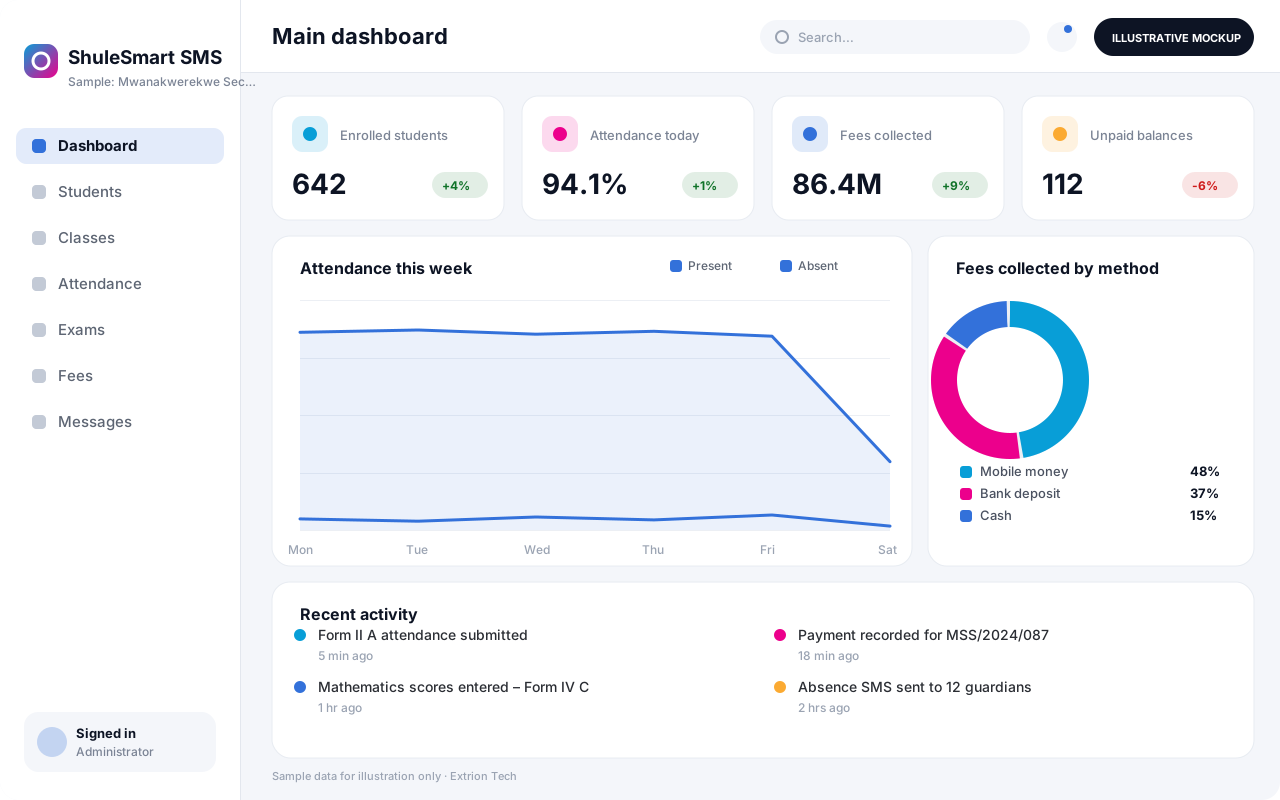 School Management System A complete school platform covering admissions, class allocation, attendance, assessments, results, fees and parent communication for primary and secondary schools.
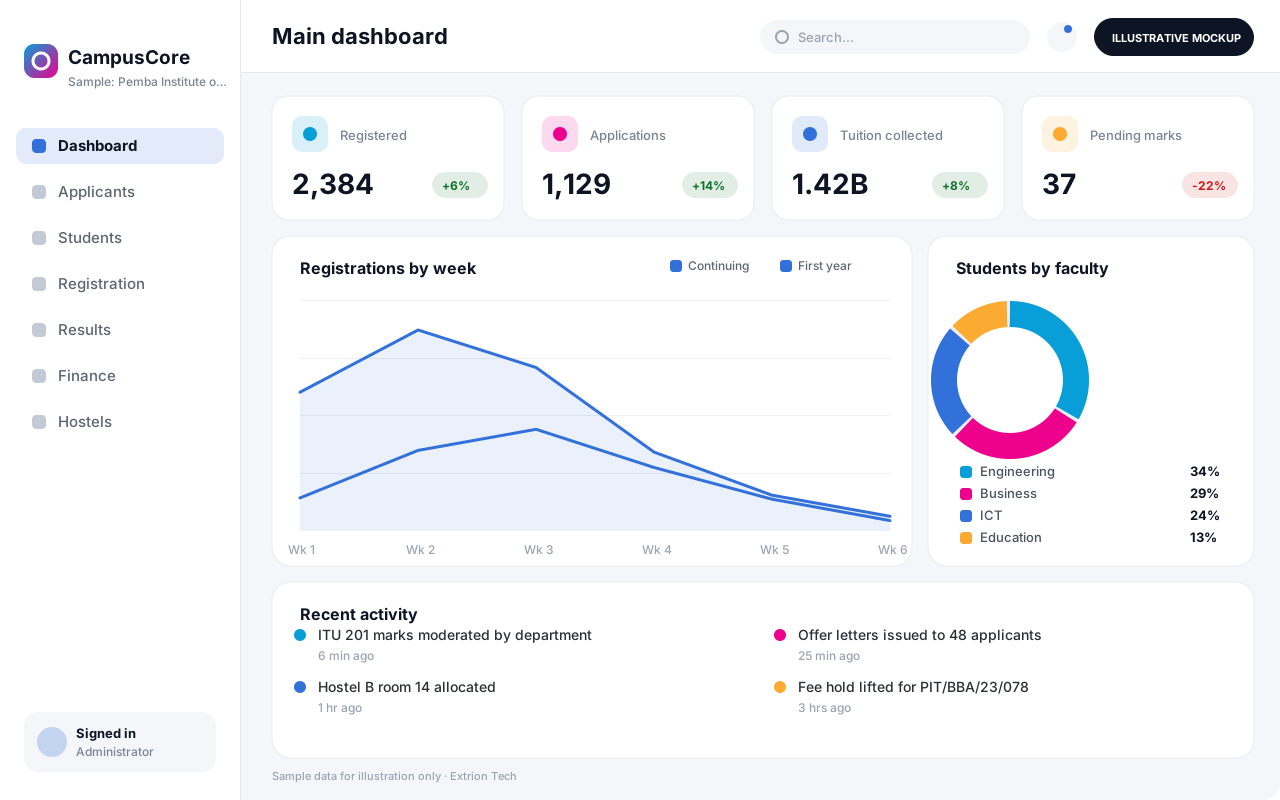 University and College Management System An institution-wide platform for programmes, applications, registration, course units, GPA, tuition billing, hostels and graduation at universities and colleges.
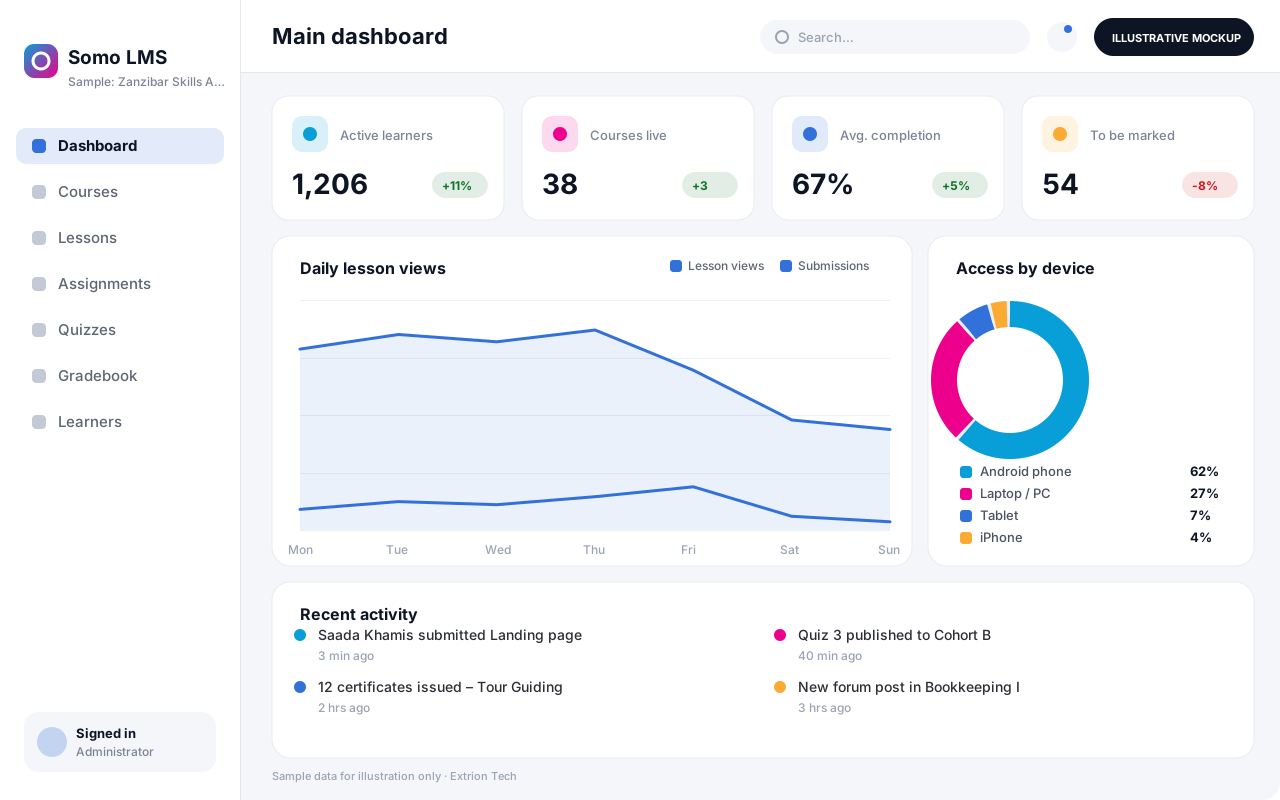 Learning Management System An online learning platform for courses, lesson materials, assignments, quizzes, discussion and progress tracking, usable on low-bandwidth connections and mobile devices.
Back to the catalogue Business software services Our development process
