Business & Enterprise
Accounting and Finance Management System
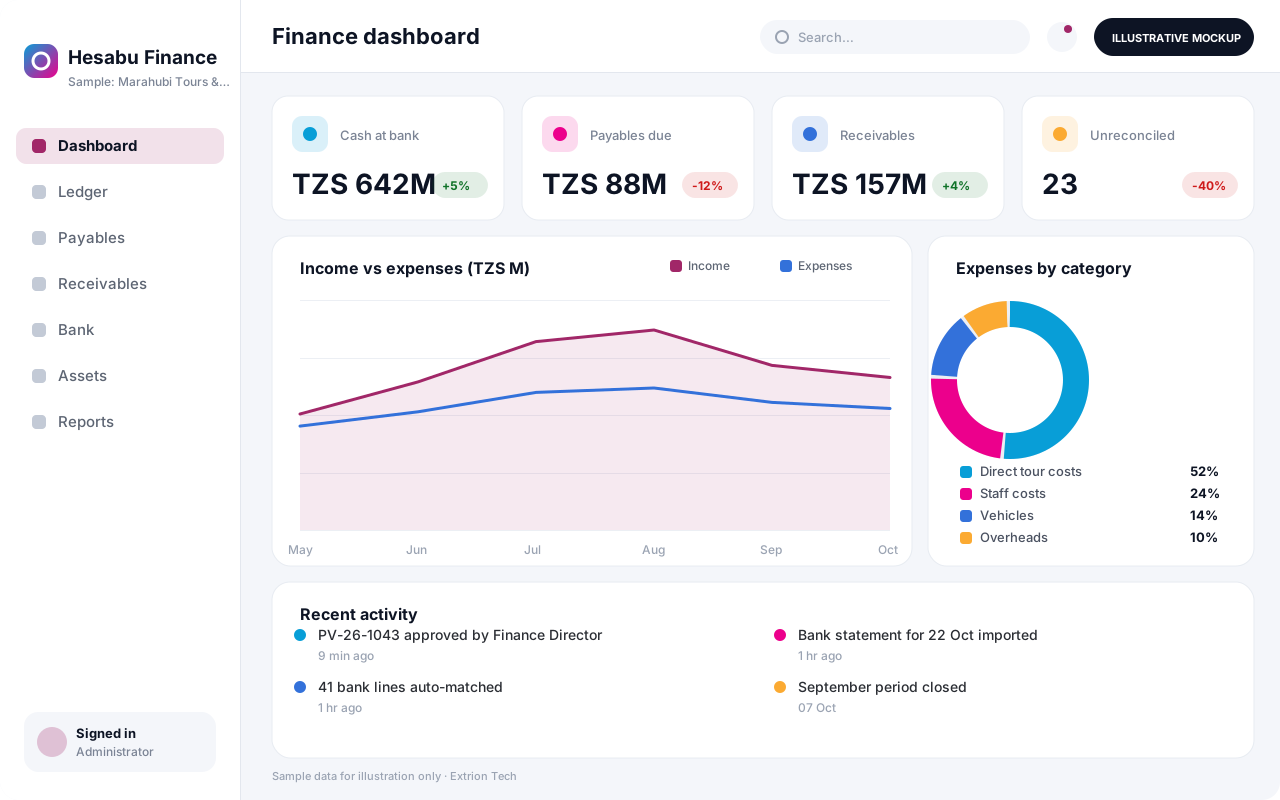
An accounting system covering the general ledger, payables, receivables, cash and bank, fixed assets and financial statements, built around your chart of accounts and controls.
- Web-based
- Server-based
Overview
Accounting and Finance Management System
Finance teams that rely on spreadsheets or basic bookkeeping tools struggle once transactions grow, entities multiply or donors and boards ask for detailed reports. Bank reconciliations fall behind, supplier balances are uncertain, and preparing a trial balance means days of manual checks. An Accounting and Finance Management System provides a disciplined double-entry ledger with the controls a finance office needs.
Extrion Tech develops the system around your chart of accounts, cost centres, funds or projects, and approval rules for payments and journals. Supplier bills, customer invoices, receipts, payment vouchers and petty cash post to the ledger automatically, and bank statements can be imported for reconciliation. Multi-currency transactions, common for tourism and import businesses in Zanzibar, can be recorded with exchange rates maintained by finance.
Period closing, the trial balance, income statement, balance sheet and cash flow are produced directly from posted entries, with drill-down to each voucher. Tax treatment and reporting formats are configured according to requirements established with the client for the relevant jurisdiction. Optional links to payroll, an ERP, fiscal receipt services or a bank are added according to project scope and where the provider offers an API.
Business problems it addresses
- Bank reconciliations are months behind, hiding errors and unrecorded transactions.
- Supplier and customer balances are uncertain because ledgers are not kept in one place.
- Payment vouchers are approved on paper with no reliable trail.
- Financial statements take weeks to prepare and depend on manual adjustments.
- Donor, project or branch reporting requires re-analysing the same transactions repeatedly.
Interface
Five screens of the system
Illustrative mockups with sample data — not screenshots of a client’s system.
Workflow
From transaction to financial statements
-
1
Source document capture
Invoices, bills, receipts and petty cash slips are entered with supporting attachments.
-
2
Coding and validation
Each entry is coded to an account, cost centre or project, and checked for balance.
-
3
Voucher approval
Payment vouchers and journals pass through the approval levels set by the finance policy.
-
4
Payment and receipting
Approved vouchers are paid and customer receipts allocated to outstanding invoices.
-
5
Bank reconciliation
Bank statements are imported and matched to ledger entries, with differences investigated.
-
6
Period close
Accruals and adjustments are posted, then the period is closed to further entries.
-
7
Financial reporting
The trial balance, statements and management reports are produced from posted data.
Functions covered
Modules and what they do
01 Ledger
-
Chart of accounts
Defines accounts, cost centres, projects and reporting groups.
-
Journals
Records general, recurring and reversing journals with approvals.
-
Period closing
Controls open and closed periods and year-end rollover.
02 Transactions
-
Accounts payable
Manages supplier bills, payment vouchers and supplier ageing.
-
Accounts receivable
Manages customer invoices, receipts, statements and ageing.
-
Cash and bank
Handles bank accounts, transfers, petty cash and reconciliations.
-
Fixed assets
Registers assets and calculates depreciation by class.
03 Reporting and extensions
-
Financial statements
Produces the trial balance, income statement, balance sheet and cash flow.
-
Fund and project accounting
Optional / subject to scope
Tracks income and spending by donor, grant or project.
-
Multi-currency
Optional / subject to scope
Records foreign currency transactions and revaluation using maintained rates.
-
Bank statement import
Optional / subject to scope
Loads statement files or feeds where the bank provides them.
Technology stack
Technology selected for this solution
These are the technologies planned for this type of system. The final stack depends on scale, performance, licensing, infrastructure, integrations and your requirements.
Frontend
Backend
Database
Infrastructure
Integrations
Security & data integrity
Protecting your data and its accuracy
Segregation of duties separates who prepares, approves and posts vouchers, and closed periods cannot be altered. Record retention and audit requirements are agreed with the client for the relevant jurisdiction.
Standard protections
-
Role-based access control
Each user sees only what their role allows.
-
Authentication and authorisation
Every request is checked for a signed-in, permitted user.
-
Fine-grained permissions
Permissions per module and action, such as view, edit or approve.
-
Secure password storage
Passwords are stored using strong one-way hashing, never in plain text.
-
Encryption in transit
HTTPS/TLS protects data between users and the server.
-
Server-side input validation
All input is validated on the server before it is saved.
-
Protection against common web vulnerabilities
Defences against injection, cross-site scripting and request forgery.
-
Database constraints and transactions
Constraints and transactions keep related records consistent.
-
Audit logs
Important actions are recorded with who, what and when.
-
User activity history
A history of each user’s activity for supervisors and administrators.
-
Backup and restoration
Scheduled backups with tested restoration procedures.
-
Session management
Session time-outs and the ability to sign out other devices.
-
Data export controls
Exports limited to authorised roles and recorded.
-
Data retention and deletion policies
Retention periods and deletion rules agreed with you.
Optional advanced protections
- Multi-factor authentication A second sign-in step for selected or all users.
- Encryption at rest Sensitive data encrypted on disk where the infrastructure supports and is configured for it.
- Disaster recovery planning A documented plan to restore service after a major failure.
- Secure API access Authenticated, rate-limited access for integrations.
Data integrity
Database constraints ensure every journal balances before it posts, and each posting is written in a single transaction across ledger and sub-ledgers. Posted entries are corrected only by reversal, and sub-ledger totals are reconciled with control accounts on every trial balance.
Security controls are configured for each project. We do not claim certification, compliance or immunity from attack unless independently verified for your deployment.
Customisation & integration
Tailored to how you work
We tailor modules, reports, permissions, workflows, branding and integrations to your organisation. Tell us which features you need when you request a quote.
- Chart of accounts, cost centres and project codes
- Voucher approval levels and signatories
- Report layouts for boards, donors or branches
- Currencies and exchange rate maintenance
- Links to payroll, ERP, banks or fiscal services
Deployment & support
From go-live to continuous improvement
Onboarding, data migration, training, maintenance, technical support and future enhancements are services we scope into your project.
Bringing records from spreadsheets or older systems, checked and reconciled.
Role-based training for users, supervisors and administrators.
Technical support and maintenance under an agreed support plan.
New modules, reports and integrations as your organisation grows.
Pricing
Pricing tailored to your requirements
Every organisation has different workflows, users, infrastructure, and integration needs. Request a quotation for a solution designed around your requirements.
- Number of users, branches and modules
- Customisation and integrations
- Hosting: cloud, your server or hybrid
- Data migration and training
- Support and maintenance plan
Business & Enterprise
Related systems
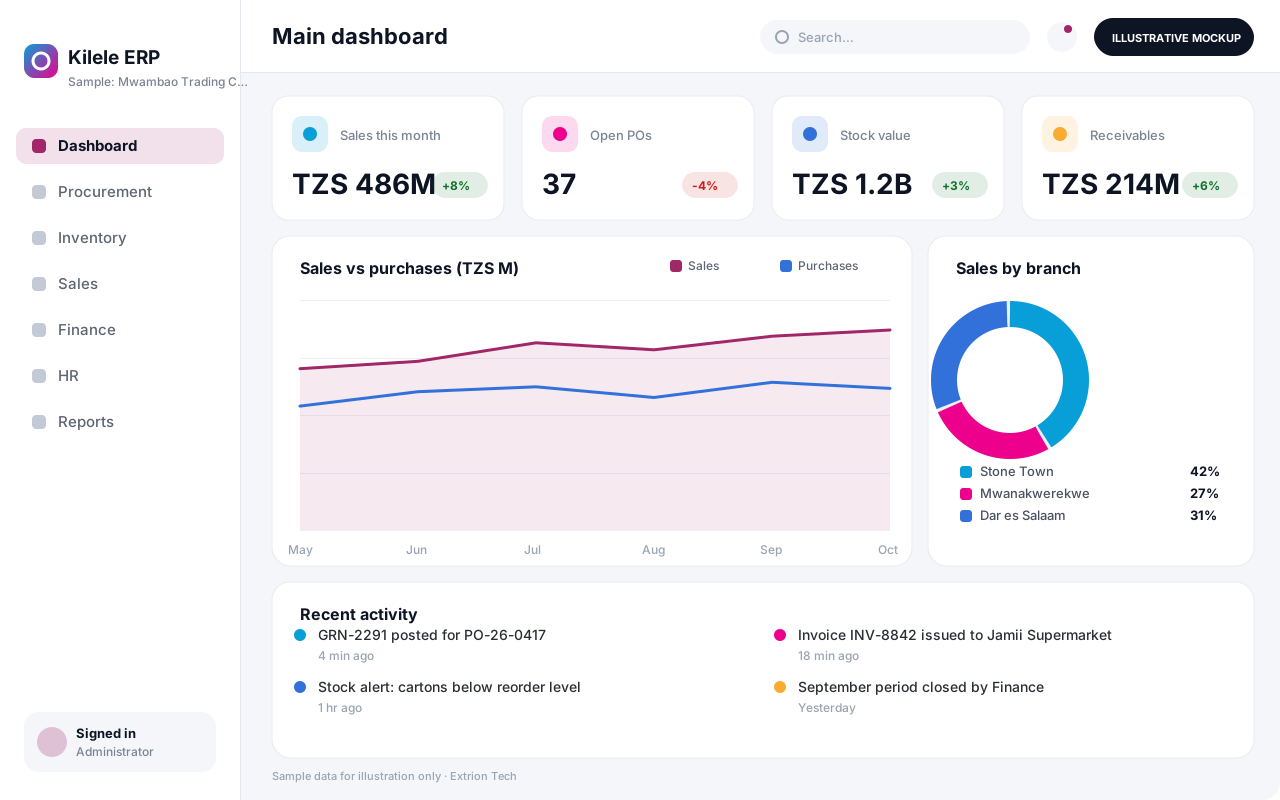 Enterprise Resource Planning System An integrated ERP that links procurement, inventory, sales, finance and HR in one database, giving management one consistent view of operations across every branch.
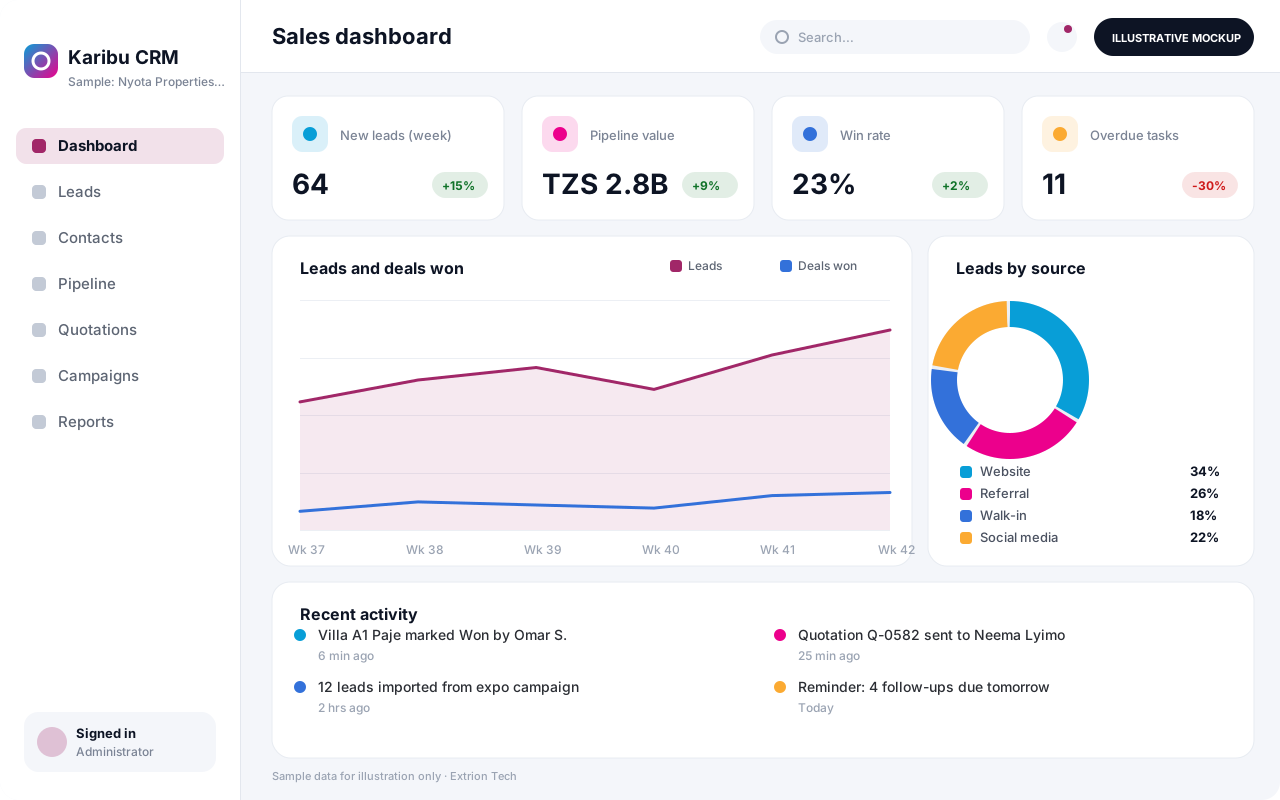 Customer Relationship Management System A CRM that tracks leads, contacts, deals, follow-ups and customer history in one place, helping sales and service teams convert more enquiries and keep accounts active.
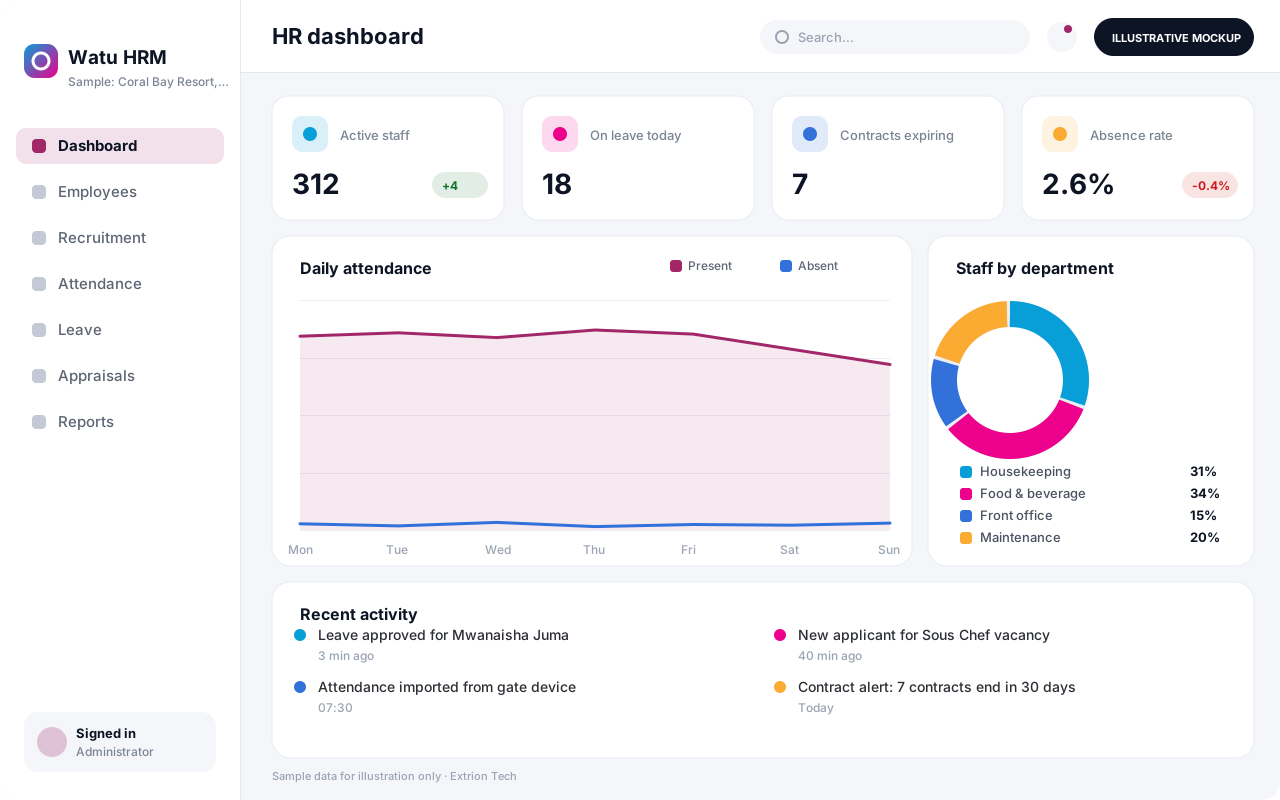 Human Resource Management System An HR system for employee records, recruitment, contracts, attendance, leave and performance reviews, with self-service so staff and managers handle requests without paperwork.
Back to the catalogue Business software services Our development process
