Bullet vs Dome Cameras: Which Is Right for Your Property?
When you plan CCTV, one of the first questions is about shape: the long "bullet" camera you see on gate pillars, or the round "dome" you see on shop ceilings? The shape matters, but not for the reasons most people think. It affects where the camera can go, how easy it is to aim, how it behaves at...
10 min read
Updated
Extrion Knowledge Center
When you plan CCTV, one of the first questions is about shape: the long "bullet" camera you see on gate pillars, or the round "dome" you see on shop ceilings? The shape matters, but not for the reasons most people think. It affects where the camera can go, how easy it is to aim, how it behaves at night, how often it needs cleaning and how hard it is to tamper with.
This guide explains those differences, introduces the turret ("eyeball") camera that sits between the two, and ends with recommendations by property type. New to CCTV? Start with CCTV Cameras Explained.
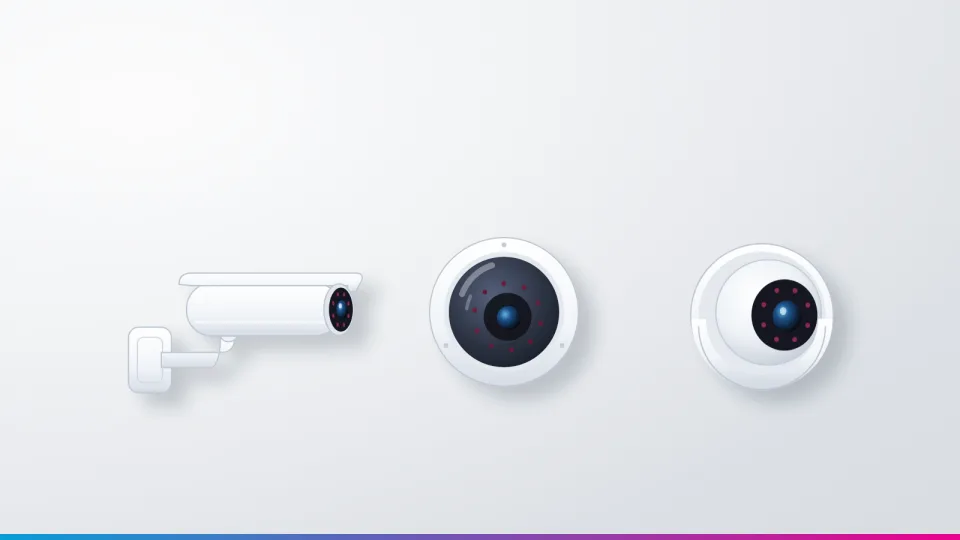
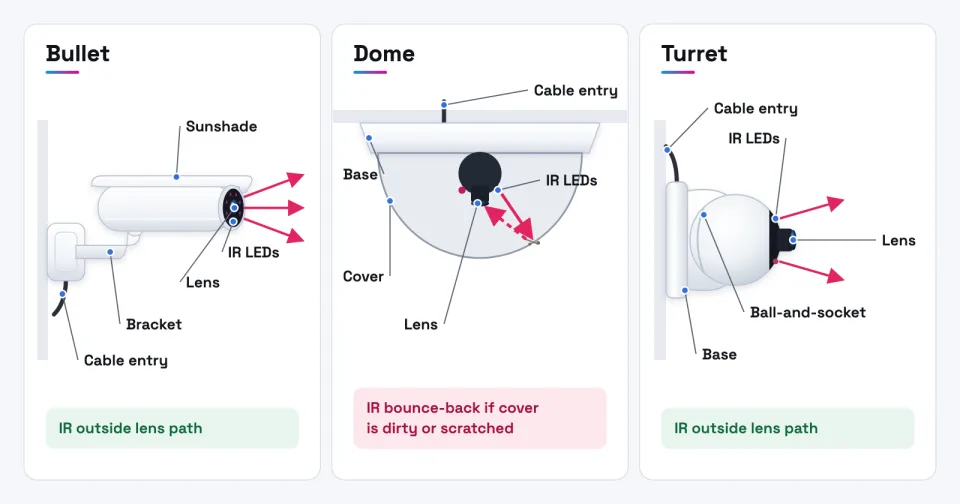
Bullet, dome and turret: three shapes, each with its own strengths.
What is a bullet camera?
A bullet camera is a cylindrical camera on an arm-style bracket. The lens sits at the front of the tube, usually under a small built-in sunshade, and the bracket lets you point it in almost any direction.
Because the body is long, there is room for a larger lens, which is why many long-range and number-plate cameras are bullets. Bullets are also easy to recognise, which is part of their appeal.
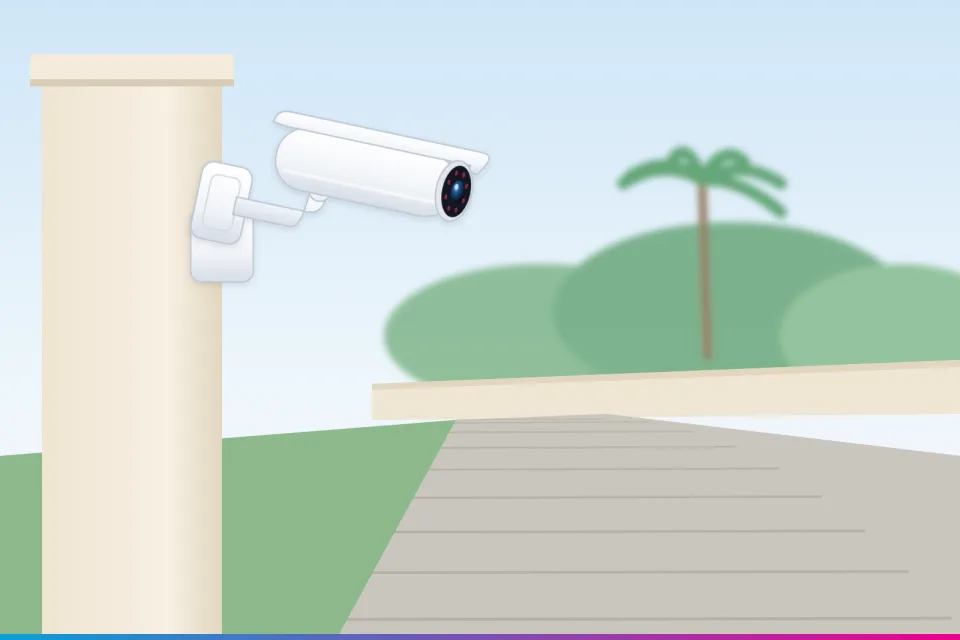
Bullet cameras suit long views such as driveways and gates.
What is a dome camera?
A dome camera has its lens and electronics inside a round housing with a clear or tinted cover (the "bubble"). It mounts flat against a ceiling or wall, and you usually remove the cover to adjust the angle.
Domes are compact and discreet, and from a distance it is hard to tell which way the lens is pointing. Many domes are also designed to be difficult to knock out of position.
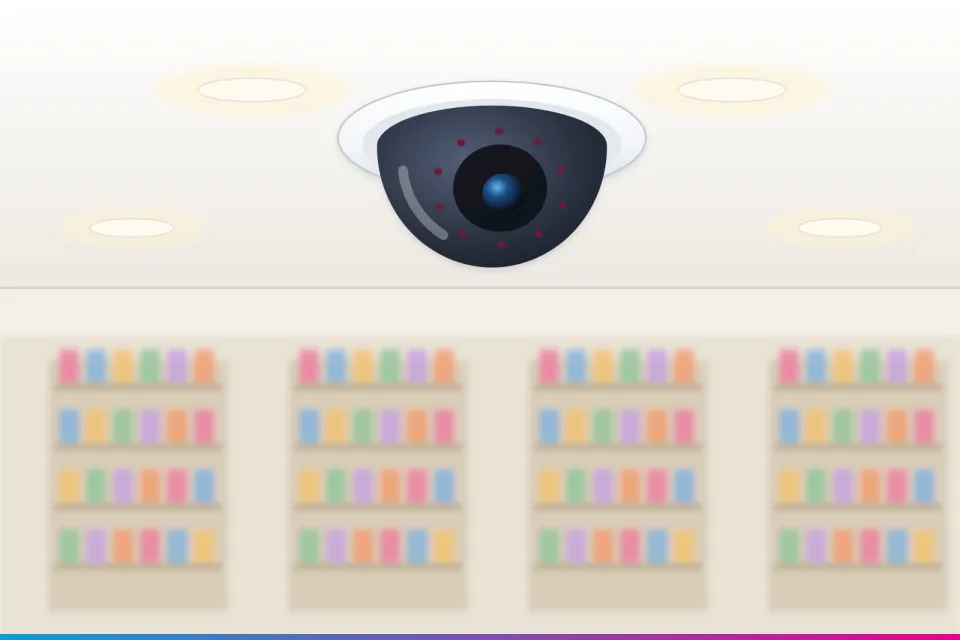
Dome cameras are compact and discreet, ideal for ceilings.
The middle option: turret ("eyeball") cameras
A turret camera looks like a dome without the bubble: a ball-shaped camera sitting in a round base. The lens and infrared (IR) lights are exposed at the front, as on a bullet, but the camera mounts close to the surface like a dome.
Turrets avoid the night-time glare some domes suffer, and their ball-and-socket mount is easy to aim. In this guide, "dome" means the bubble type.
Design differences at a glance
The main difference at night: on a dome, IR light passes through the same cover as the lens.
Bullet
Dome
Turret
Shape
Tube on an arm bracket
Low profile under a cover
Ball in a round base, no cover
How obvious it is
Very visible
Discreet
Moderately visible
Aiming
Easy, adjust the bracket
Remove the cover, rotate the module
Easy, rotate the ball
Typical lens
Wide to long-range zoom
Wide to medium
Wide to medium
Night-time IR
Lights outside the lens path
Can reflect off a dirty or scratched cover
Lights outside the lens path
Cleaning
Lens glass and sunshade; spider webs
Whole cover; scratches easily
Small front glass
Tamper resistance
Easier to knock or redirect if in reach
Often best, if the model is impact-rated
In between
Typical places
Gates, driveways, perimeters, car parks
Ceilings, reception, tills, corridors
Walls and eaves, entrances, indoors or out
These are typical traits, not rules. The specification of the actual model always decides.
Typical mounting positions
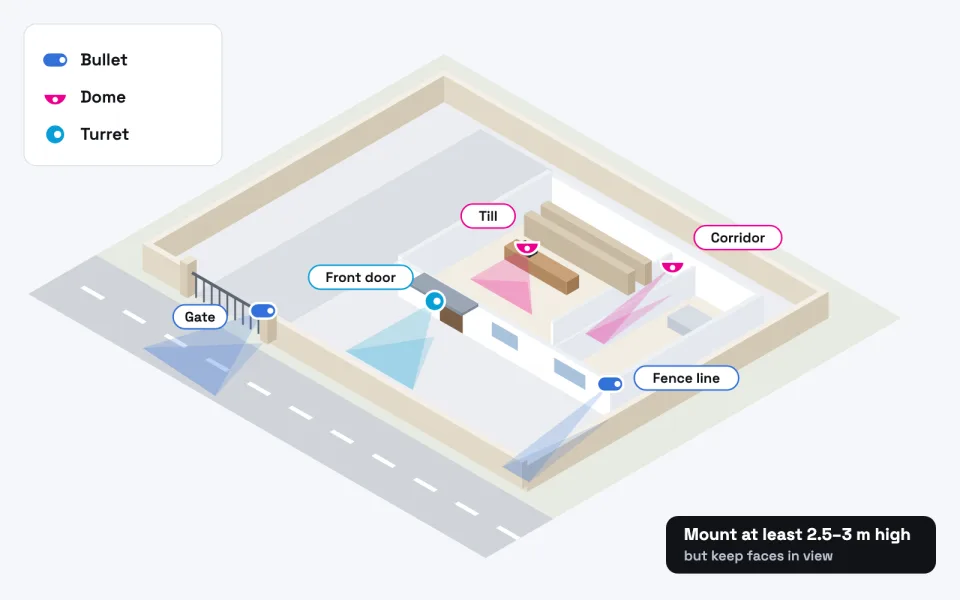
A typical mix: bullets on the perimeter, a turret at the door and domes inside.
Bullets are usually wall-mounted or pole-mounted, high on an outside wall or gate pillar, pointing along a driveway, fence line or road.
Domes are usually ceiling-mounted indoors (reception, shop floor, corridors, lifts) or under an outdoor roof overhang. They look neatest on a flat ceiling.
Turrets suit both walls and ceilings and are a common choice under eaves and above doorways.
Whatever the shape, mount the camera where it cannot easily be reached, ideally at least 2.5 to 3 metres up. Then make sure the angle still shows faces, not just the tops of heads.
Visibility and deterrence
A visible camera tells people they are being recorded, and that alone deters some opportunistic theft. Bullets do this best because everyone recognises the shape (Avigilon).
Visibility has a cost: a bullet within reach can be knocked, sprayed or turned away. A dome blends in and hides where it is looking, which suits hotel lobbies, offices and premium shops.
Tip You don't have to choose one. Many properties use a visible bullet or turret at the gate as a deterrent and discreet domes inside.
Field of view and mounting flexibility
How much a camera sees depends on its lens, not its shape:
Fixed lens: one viewing angle, chosen when you buy. Fine when you know exactly what you need to see.
Varifocal lens: the installer can zoom in or out during set-up, from a wide view to a narrower, more detailed one. Motorised varifocal models can be adjusted from the recorder or app, which saves a ladder trip.
Bullets suit long, narrow views, such as a face or number plate at a distant gate, because they can house bigger lenses. Domes and turrets usually cover wider, closer areas: a room, a till or a doorway. Re-aiming is quickest on bullets and turrets; on a dome you usually remove the cover.
Maintenance and cleaning
This is where the shapes really differ.
Domes: the cover sits in front of the lens and the IR lights. If it is dusty, wet, scratched or badly seated, IR light can bounce back into the lens at night and wash the picture out. Installers call this "IR bounce-back" or "flare" (Avigilon; IPVM installer discussion). Clean the cover with a soft microfibre cloth, never a shirt or tissue, which can leave fine scratches.
Bullets: the IR lights shine past the lens, so bounce-back is rarely a problem. But the warm housing and the light attract insects, and spider webs across the lens trigger false motion alerts and blur the night picture.
Turrets: the IR lights are separated from the lens and there is less surface to collect dirt, which is why many installers like them outdoors.
Near the coast, salt spray dries into a film on any glass and can corrode cheap screws and brackets. Dusty roads and construction sites coat lenses quickly. Plan a cleaning visit every few months and check the brackets at the same time.
Wipe lenses or dome covers with a microfibre cloth
Remove spider webs and insect nests
Check brackets, screws and cable glands for rust or looseness
Review a night-time recording for glare or haze
Weather protection and vandal resistance: IP and IK ratings
Shape tells you little about toughness. Two international ratings do, and they should appear on the datasheet.
Protected against powerful water jets, such as driving rain
IPx7
Protected against temporary immersion (tested at about 1 m)
IP66 is the usual minimum for an exposed outdoor camera. IP67 is not automatically "better" than IP66: the standard treats jets and immersion as different tests, which is why some cameras state both, written "IP66/IP67" (IEC 60529).
IK rating (impact protection, standard IEC 62262). This measures how hard a blow the housing survives, from IK01 up to IK10 (20 joules), with IK11 (50 joules) added in 2021 (summary). For cameras within reach of the public, look for IK10.
Warning Not every bullet is rated for outdoor use, and not every dome is vandal-resistant. Cheap indoor domes have thin covers that crack easily. Always check the IP and IK figures on the datasheet for the exact model.
Night vision and image quality
By day, image quality depends on the sensor, lens, resolution and settings, not the shape.
At night the shape does matter:
IR range. Bigger bullets often have stronger IR lights for longer range. Check the stated IR distance, and remember it is measured in ideal conditions.
Dome bounce-back. As described above, a dirty or scratched dome cover is the most common cause of hazy night footage.
Nearby surfaces. Any camera mounted close to a wall, gutter or roof edge can pick up IR reflected from that surface. Leave clearance and check a night recording before you finish.
Colour night vision. Some models use a white light or very sensitive sensors to show colour at night. That is a model feature, not a shape feature.
Cabling. Most professional IP cameras take data and power over one network cable (PoE). Every shape needs a weatherproof cable entry; bullets and turrets often use a junction box. The PoE Budget Calculator checks your switch can power them all.
Ceilings. Recessed (flush) dome installs look tidy but need a ceiling cut-out and more labour.
Power cuts. Whatever you install, put the recorder and PoE switch on a UPS so recording continues during outages.
Budget. Price depends more on resolution, lens, night vision, IP/IK ratings and brand than on shape. One varifocal bullet covering a long driveway may replace two fixed cameras. For figures for your site, use the Smart Quotation.
When each is appropriate
Choose a bullet when:
you need distance, such as a long driveway, fence line, car park or number plates
you want an obvious deterrent
the camera can be mounted out of reach
Choose a dome when:
the camera is indoors on a ceiling
people can reach it, or vandalism is a real risk (choose an IK10 model)
you want it discreet
Choose a turret when:
you want clean night images without dome glare
the camera goes under eaves or above a door
you want one camera type for most positions
Choosing for your property
Property
Usual mix
Why
Home
Turrets or bullets outside; one or two small indoor domes if needed
Clear night images at gate and doors; easy to aim
Shop
Domes over tills and aisles; a turret or bullet at the entrance
Discreet inside, tamper-resistant within reach, faces at the door
Office
Domes in reception and corridors; turrets at entrances and car park
Professional look; covers who comes and goes
Hotel / guest house
Discreet domes in lobby and corridors; turrets or bullets at gate, car park and service areas
Guests stay comfortable; perimeter is well covered. Never place cameras where guests expect privacy
Outdoor entrance or gate
Varifocal bullet or turret, IP66 or better; IK10 if reachable
Distance for faces and plates; weather and tamper protection
Neither is better overall. Domes are discreet and often more tamper-resistant; bullets are easier to aim, more visible and better for long distances. Choose by location and the model's specification.
Can I use a dome camera outdoors?
Yes, if the datasheet shows an outdoor IP rating, usually IP66 or better. Mounting it under a roof overhang also keeps rain and sun off the cover, which reduces cleaning and glare.
Why is my dome camera's night picture hazy?
Usually a dirty, wet or scratched cover reflecting the camera's own IR light. Clean it with a microfibre cloth, check that the foam or rubber ring around the lens sits properly, and check for nearby walls or eaves reflecting light.
What does IK10 mean?
It is the highest impact rating in common use under IEC 62262: the housing withstands a 20-joule impact. It is worth having for any camera within reach.
Which camera is best near the sea?
Shape matters less than build quality. Choose IP66 or better, check that brackets and screws resist corrosion, mount under shelter where possible and plan regular cleaning to remove salt film.
All three shapes can produce excellent footage. The right choice depends on where each camera goes, what it must see, who can reach it and how often it will be cleaned. Most good systems mix them.
List each spot you want covered and what you need to see there (a face, a plate or general activity).
Use the decision guide above to pick a shape for each spot.
If you would like a second opinion, Extrion's security and surveillance team can review your property and suggest a layout, or you can list your cameras in the Smart Quotation Builder and request prices when you are ready.
This guide is general information to help you plan. Prices, product features and regulations change, so confirm the details for your own site before you buy.
We use essential cookies to keep this website secure and working. With your permission we also remember your preferences and play embedded videos. No advertising trackers, ever. Read our cookie notice


 Security & Surveillance
10 min